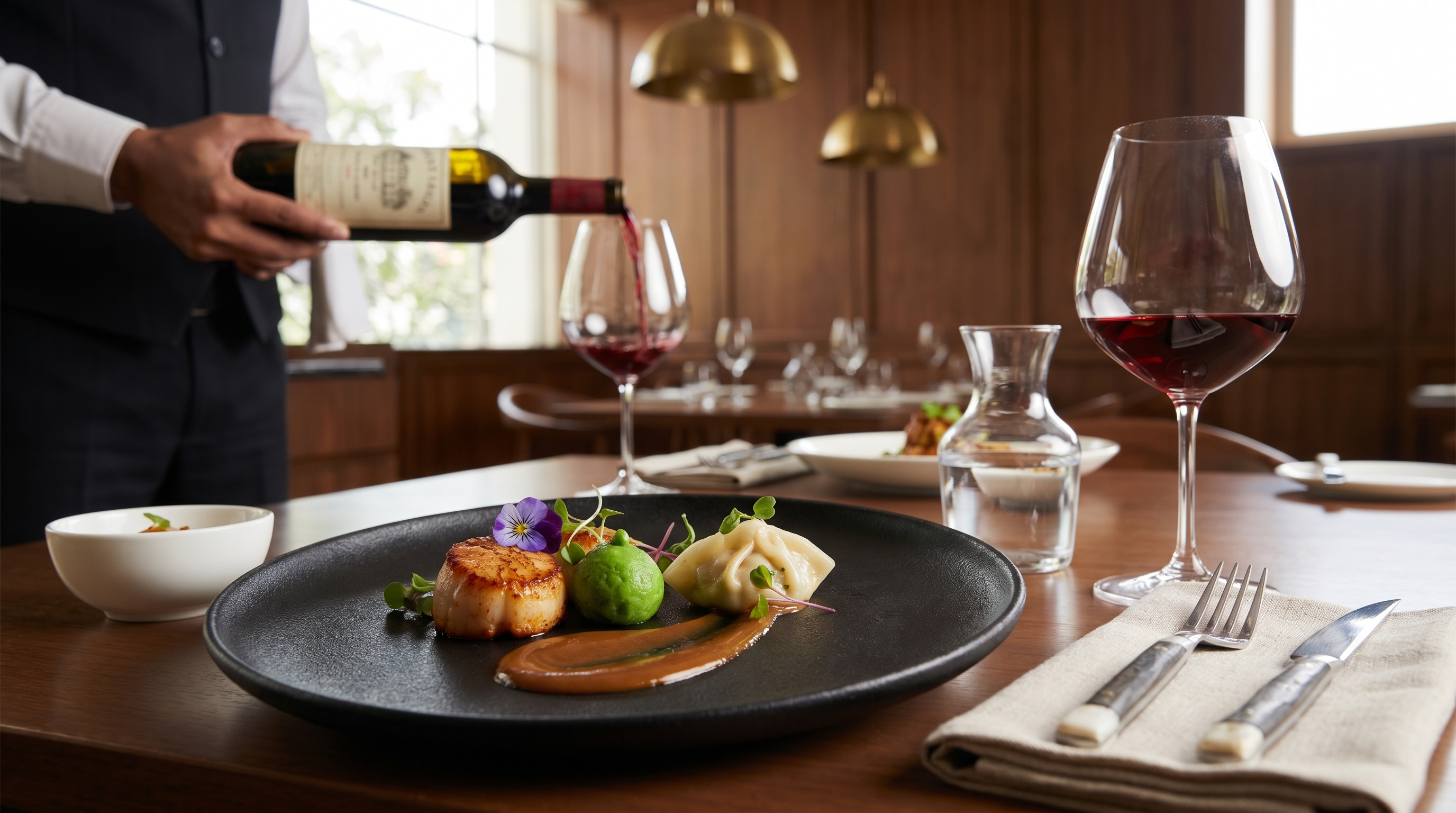
The plate is not a vehicle for food. The plate is the food's first paragraph. By the time the diner's tongue catches up, the porcelain has already done the lifting that the chef hopes the seasoning will complete: the weight in the hand, the curve at the rim, the colour under the lamp.
Professor Charles Spence at Oxford's Crossmodal Research Laboratory has been making this argument for twenty years. Two of his findings are the working ground. The same dessert tastes sweeter on a round plate than on an angular one. And heavier cutlery — the same food, served with a 220-gram spoon instead of a 110-gram one — gets rated higher and earns a higher willingness to pay.
Heston Blumenthal made the same point with showmanship instead of statistics. Sound of the Sea, on the Fat Duck menu since 2007, arrives in a wooden box of edible sand with a conch shell containing an iPod playing waves and gulls. Some diners, Blumenthal noted, were so moved they broke down in tears. A small box of sand. An iPod in a conch shell. No new ingredient on the plate.
The seasoning is the last sense to land. By the time it does, half the work is already done.
The Indian table is making the same turn
For most of the last twenty years, this argument was a Mayfair argument. It belonged to two restaurants in London, one in Bray, one in Copenhagen and a string of footnotes in food magazines. Indian fine dining was elsewhere — competing on portion, novelty, chef-name, location. The plate itself was a logistics problem, not a creative one.
That changed quietly, somewhere around 2018.
The clearest expression of the shift is Garima Arora at Gaa, Bangkok. Two Michelin stars, the second won in 2023 while she was pregnant. She trained at Le Cordon Bleu, then Noma under Redzepi, then Gaggan, before opening her own room. Her rule on plating is the one most often quoted back at younger Indian chefs: "Anything on the plate should add something to the dish itself. Flavor always trumps visuals."
Her tableware is commissioned. The pieces holding her food are by Claymen, Aman Khanna's New Delhi studio. Khanna trained at London College of Communication and came home to set up a workshop that makes pieces with what he calls "deliberate deformities." Stoneware glazed in gradients of grey, azure, black and brown. Not perfect. Not symmetrical. Honest in a way that machine-pressed porcelain cannot be.
The plate and the dish are making the same argument now: pared back, sure of itself, at peace with its imperfections.
Up at the other end of the country, in Kasauli, Prateek Sadhu at Naar runs the most uncompromising version of the same idea. Sixteen seats. Six menus tied to six Himalayan seasons. Eighty per cent of the menu foraged. And the plates rotate with the seasons.
Once a chef has said that out loud, it becomes hard to take a printed white circle of factory porcelain seriously again.
What to actually specify
A working operator who has decided that the plate is a creative problem still has to source plates. The category breaks down into four tiers and a glassware ladder. Most F&B procurement teams work through them in the same order.
Porcelain is the five-star workhorse. Steelite, Villeroy & Boch, Bauscher Hepp, Rosenthal, Schönwald. Specify by chip resistance, dishwasher-cycle warranty and edge geometry — premium porcelain is rated for thousands of cycles, mid-grade is not.
Bone china is the banquet tier. Hold the plate to the light; you should see your fingers behind it. Tap it against a fork tine; it should ring. The brands worth knowing — Wedgwood and Royal Crown Derby on the heritage European side, Narumi and Noritake on the Japanese-precision side that ITC and Taj banquets already specify.
Stoneware and hand-thrown Indian ceramics is the tier no one was specifying in 2018 and almost everyone is specifying in 2026. Artevo, the Bombay stone-and-clay studio. The Wishing Chair in Pune. Andretta in Himachal. Smaller studios — Kari, Laima, Stonessa — supplying the rooms that don't want every other dining room in their city to be eating off the same plate.
Melamine is for volume — banquet stacking, casual dining, room service. Carlisle, Cambro. It works. It reads casual the moment it hits the table.
For glassware, the ladder is shorter. Riedel, Spiegelau, Schott Zwiesel at the premium European tier. Lucaris, marketed as the Crystal of Modern Asia, at the mid-tier where durability matters and import cost is a question. Rona, the century-old Slovak crystal house, distributed in India through Harbour Hospitality. For whisky, the global tasting standard is the Glencairn; both Paul John and Amrut sell their single malts with branded Glencairns because the glass is the tasting protocol.
One compliance note worth carrying in a procurement spec. Traditional leaded crystal contains 24 per cent lead oxide — the source of its brilliance and a reason it's been quietly leaving hospitality kitchens for fifteen years. Premium European glassware moved to lead-free crystalline (titanium, zinc or potassium oxide-based) for both food-safety and dishwasher-durability reasons. FSSAI's Food Safety and Standards (Packaging) Regulations 2018 govern food-contact materials in India. Specify lead-free in tender documents. Ask for the compliance certificate.
The operator's answer
Every chef who has decided that the plate is part of the menu eventually runs into the same operator question: who do I source from, who understands what I'm trying to build? In India, the increasingly common answer is Harbour Hospitality, founded in Mumbai in February 2021 by Managing Partner Karan Khiani.
Khiani's path is the detail. Glion alumnus, the Swiss hospitality school whose graduates run global luxury hotels. F&B manager at the InterContinental Marine Drive Mumbai at twenty-seven. In 2003 he started Kiros Hospitality Solutions, now a twenty-three-year-old institution that has supplied tableware, glassware and back-of-house equipment to Taj, Oberoi, Hyatt, Hilton, Kempinski and Marriott across India.
Harbour Hospitality, started eighteen years later, is the design-forward successor. Same operator. Different proposition. Where Kiros is the wider-net supply business, Harbour is the curated luxury-import platform built for the fine-dining era that the broader business wasn't designed to address. The portfolio reads like a who's-who of premium European tabletop and glassware: Steelite from the UK, Serax from Belgium (Sergio Herman's design house), Studio William cutlery, Cookplay, Rona, LSA International, Utopia, Bar Professional, Craster, Vollrath. Alongside the imports, Harbour runs its own in-house line, Artevo, a stone-and-clay studio designing and producing hand-thrown pieces in India for the country's fine-dining rooms. Geography: India and the Maldives.
The brand language is consciously not a vendor's. The proposition is curation, not catalogue. The next line of work the company has named publicly is bespoke F&B concepts: tabletop programmes designed for individual restaurant launches, not pallets shipped against a purchase order.
The people building serious rooms in India are now sourcing through someone who has stood in their kitchen.
What's coming next
Three trend lines through the rest of this decade.
Indian artisan ceramics become the default, not the exception. Claymen, The Wishing Chair, Andretta, Kari, Laima, Stonessa. What was a niche specification in 2018 is now the standard for any tasting-menu room opening in 2026. The tactile turn, away from the sterile flat white porcelain of the previous generation, is being supplied by a half-dozen ateliers within India's own pottery traditions.
Sustainable tableware moves up-market. Bagasse and palm-leaf are no longer cloud-kitchen disposables. F&B teams now specify them for poolside, garden weddings and festival pop-ups — anywhere reusable porcelain is logistically impossible and where the operator wants to make a sustainability statement that the guest can hold in their hand.
The plate becomes part of the menu, not part of the kit. Naar has already done it: six menus, six plate sets, the seasons of the food dictating the seasons of the porcelain. The next generation of tasting-menu rooms will commission new plates per course, not just per season. The ceramic atelier becomes a creative partner of the chef, not a procurement line.
The first sense to land at a meal is still sight. The operators who understand that are the ones commissioning the plates.
Sources & references 8
Kaam Hire is the hospitality-only hiring platform that powers this blog. If hiring is on your mind — try it.