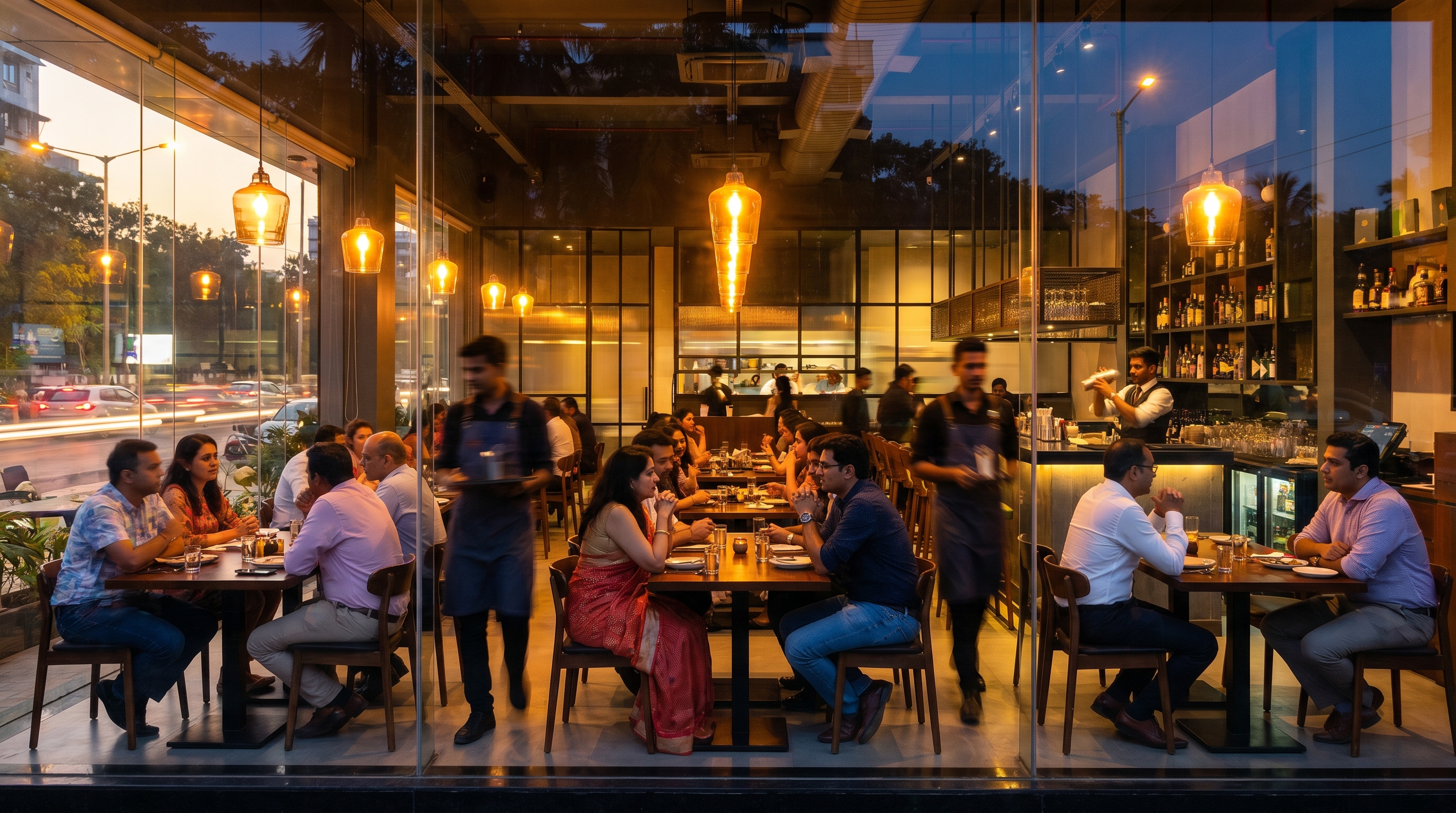
There is a way to measure the rise of Indian hospitality that captures it better than any market-size projection. In 2018-19, the average urban Indian ate out 6.6 times a month. In 2024, that number was 7.9. The NRAI's India Food Services Report 2024 frames this almost in passing — a 20% jump in five years — and moves on to the macros. The data point is doing more work than it lets on. Cooking at home is in structural retreat in urban India. The kitchen at home is no longer the default unit of how a family eats. That single shift is what every other number in the report ultimately measures.
The numbers, in order of how much they matter
India's food services industry is worth ₹5.69 lakh crore in FY24 and is projected to reach ₹7.76 lakh crore by FY28, growing at 8.1% CAGR. It contributes 1.9% to GDP. It employs 8.5 million people directly, projected to cross 10.3 million by 2028 — a 21% expansion in four years. The organised share is moving from 43.8% in FY24 to 52.9% by FY28, growing at 13.2% versus the unorganised sector's drift.
What this means, in plain English: within four years, the majority of how Indians eat out will be branded, chain-led, formal. This has never happened in this country before. India has historically been a market of independents — the corner café, the family restaurant, the regional chain. The flip to organised majority is the regime change underneath everything else in this article.
Tier-2 and tier-3 are not the future — they are the present
The organised-restaurant story used to be a metro story. Mumbai, Delhi, Bengaluru, Hyderabad, Chennai, Pune, Kolkata. The 2024 data has broken that frame definitively.
Ninety-four per cent of restaurant operators surveyed by the NRAI told it they were planning expansion into tier-2 and tier-3 cities. Indore, Patna and Goa each saw 25-26% growth in restaurant store launches over 2024-25, a faster pace than any metro. Lucknow, Surat, Kochi, Coimbatore, Bhubaneswar and Visakhapatnam are now treated as primary expansion markets in board decks, not afterthoughts.
The economics work because the cost base flips in the operator's favour. Tier-2 retail rents run at roughly one-tenth of metro highstreet rates. Real-estate availability is structurally easier. The local consumer has been pre-conditioned by aggregator delivery for three to four years and now reads QSR menus and premium-casual menus the same way a Bandra customer does. The talent pipeline is harder — most tier-2 cities still don't have a senior captain layer — but operators are filling the gap with metro transfers and accelerated promotions.
Mumbai still leads in absolute size — ₹55,181 crore in organised F&B as per the NRAI's split — followed by Bengaluru at ₹26,475 crore and Hyderabad at ₹10,161 crore. But growth rates favour the smaller cities. The next ten-year operator playbook will look very different from the last ten.
The palate has diversified faster than the supply chain
What Indians eat in 2026, in upper-middle-class metros, has almost no overlap with what they ate in 2016. The shifts most operators have stopped noticing because they are now normal:
- Korean food moved from "trend" to "menu staple" between 2022 and 2024, accelerated by the streaming wave (Squid Game, K-drama, K-pop) and now anchored by domestic supply chains. McDonald's India ran a Korean-inspired menu in 2024. Knorr launched a Korean ramen and a Korean hot-pot ready meal. Korean-fried-chicken concepts have opened in seventeen cities including Surat and Lucknow.
- Sushi, ramen, hand-pulled noodles have entered the ₹600-1,200 per-cover band that was, until 2020, the preserve of five-star restaurants. The mid-market sushi count in Bengaluru roughly tripled between 2020 and 2024.
- Mediterranean and Levantine — Olive's reinventions, Komorebi, Bayroute, the entire mezze-and-pita category — now have a credible standalone audience, not just hotel-restaurant clientele.
- Plant-forward dining, distinct from "vegan-marketing-led" plays, is finding paying customers in metros. Greenr, ARQ and Veganarke aren't there yet at scale, but they are no longer fringe.
- Sober-curious is mainstream. Roughly 72% of affluent drinkers across ten Indian cities took an alcohol break in 2024. Zero-proof cocktail bars (Lair, Boilermaker, Soka, Sidecar) are running full at dinner. Specialty kombucha is now a daypart strategy at gastropubs, not a wellness niche.
- Specialty coffee replaces instant for an entire urban demographic. Starbucks India growth has cooled to roughly 5%, while Blue Tokai, Third Wave and Subko collectively cross ₹600 crore in FY25. Nescafé's mass-market dominance is being eroded at the urban premium end at the same speed as basmati is being eroded by foxtail millet in upper-middle-class kitchens.
The quick-commerce shock
Quick commerce is the variable everyone in F&B underestimated in 2022 and now has to plan around. Q-commerce revenue in India hit ₹11,110 crore in FY25, up 150% YoY. Blinkit holds approximately 50% of the market, with Zepto and Swiggy Instamart contending for second. Blinkit alone crossed thirty million weekly active users.
For the restaurant industry, the new threat isn't grocery — it is the snack and coffee daypart. Zepto Cafe, Blinkit Bistro and Swiggy Bolt are eating the under-30-minute snack-and-beverage market that QSR took for granted. The top three Q-commerce operators have collectively burned $1.4 billion in four years, which means the unit economics are still being subsidised by VC money — but the consumer behaviour is locking in regardless of who eventually wins the platform war.
The QSR brands that adapted earliest (Wow Momo, KFC, Burger Singh) are running smaller-footprint express formats designed for Q-commerce dispatch as well as walk-in. The brands that didn't are slowly losing ten to fifteen per cent of evening snack-window revenue to a Zepto cafe two streets over.
The hotel side of the rise
The other half of "the rise of hospitality" — the hotels — has had a quieter but bigger story. India hotel-deal volume hit $93 million in H1 2024, on track for $413 million for the full year, up 22% YoY. The Indian Hotels Company (Taj, Vivanta, Ginger) reached its 300-hotel milestone two years ahead of schedule in April 2024, and joined the ₹1 lakh crore market-cap club in September 2024 — the eighth Tata company to do so. Ginger, IHCL's value brand, is now the group's growth engine. ITC Hotels demerged into a separately listed entity in 2025. Lemon Tree is at 160+ hotels and pushing aggressively into tier-2.
The capacity build-out is happening alongside an unprecedented run on Indian weddings. The CAIT estimates the October-December 2024 wedding season at ₹6 trillion of business across 4.8 million weddings, with average spend of ₹36.5 lakh and destination-wedding average of ₹51.1 lakh. The wedding economy is India's fourth-largest industry by some measures. The destination-wedding market alone is projected to grow from USD 16.25 billion in 2024 to USD 55.4 billion by 2033.
This is the silent engine under the entire hospitality talent shortage. A 400-pax wedding banquet in Udaipur needs 80 to 120 trained service staff for three days. The supply doesn't exist. Hotels are rotating staff between properties for marquee weddings, and standalone restaurants in destination cities run with 40% of their permanent staff supplemented by 60% wedding-season casual labour, most of whom learn on the job.
The talent shortage is the silent constraint on everything above
India has roughly 30,000 hotel-management graduates a year against an industry need of approximately 3.8 lakh trained hospitality professionals annually. The hotel-side skilled-manpower shortfall sits at 55-60%. The deficit isn't filled — it just goes unsung.
This is the constraint that operators don't put on the cover slide of their investor decks. Every restaurant-group expansion plan presented in 2025 assumes the cooks and captains can be hired. They mostly cannot, at the wage points the unit economics assume. The brands that have built durable talent pipelines (IHCL with its 28,000-trained CII-EHL programme, Oberoi with STEP, Westlife with Welingkar) have a structural advantage that doesn't show up in any quarterly earnings call but compounds across every new outlet they open.
Where the capital is flowing
F&B venture capital deal activity hit its highest-ever level in 2024, up 43% YoY according to Posist's Restaurant Times reporting. The headline rounds tell the story:
- Hunger Inc closed ₹215 crore in 2025 (Lighthouse, DSG Consumer Partners).
- Curefoods raised ₹160 crore pre-IPO from Binny Bansal's 3State Ventures and filed for an ₹800 crore IPO.
- Burger Singh raised ₹82 crore Series B at a ₹520 crore valuation in March 2026.
- The Belgian Waffle Co sold 45% to Vixar/Arpwood for roughly ₹770 crore in December 2025, valuing the chain at ~₹1,700 crore.
- Boba Bhai raised ₹40 crore at a 5x valuation jump in February 2026.
- Subko closed a $10M Series B led by Blume Ventures and Nikhil Kamath in January 2024.
On the other side of the same year, the cloud-kitchen funding correction continued — Rebel Foods FY25 losses at ₹336 crore, EatClub raising flat at $540 million post-money on a Tiger Global round. The market has stopped pricing pure-virtual on growth and started pricing it on profitability.
The IPO pipeline reads as a list of who is closest to the public market: Curefoods (₹800 crore DRHP filed), Wow Momo (FY27 target), the merged Devyani-Sapphire entity if the talks conclude, Hunger Inc when it's ready. The dine-in side — Devyani International, Sapphire Foods, Westlife Foodworld, Restaurant Brands Asia — has been publicly listed for years now. The cloud-kitchen side is finally catching up, and the market is waiting to see who can run a profitable virtual-first business at scale, because no one has done it convincingly yet.
What changed, and what is coming
The eight things that have changed, summarised:
- Indian urban consumers eat out 20% more often than five years ago, and the floor is still rising.
- The organised restaurant share will cross 50% by 2028 — a regime change without historical parallel in this country.
- Tier-2 and tier-3 cities are now primary expansion markets, not afterthoughts.
- The palate has diversified — Korean, sushi, Mediterranean, plant-forward, sober-curious are no longer fringe.
- Specialty coffee has overtaken Starbucks in growth momentum at the urban premium end.
- Quick commerce has rewritten the snack-and-beverage daypart.
- Hotel capacity is expanding fastest at the value end (Ginger, Lemon Tree), and weddings are subsidising the gap on the talent side.
- The capital flow has favoured branded fast-casual and dessert-as-gifting in 2024-25, and has cooled on pure cloud-kitchen plays.
The three things to watch over the next twenty-four months:
- The Devyani-Sapphire merger. If it closes, it consolidates the Indian Yum! franchise universe into a single entity. The implications for QSR labour markets in India will be material.
- The first profitable cloud kitchen IPO. Curefoods has filed. Rebel has been preparing for years. The first one to list and trade above issue for six months will define the playbook.
- The first standalone speciality coffee chain to cross ₹500 crore. Blue Tokai, Third Wave or Subko, in that order of probability. Whoever does it first will rewrite the venture maths for the next decade of Indian F&B.
The rise of hospitality in India is no longer a forecast. It is a present-tense story being told in slow motion across 8,500 cities and towns. The interesting question isn't whether it continues. It's who builds the durable institutions inside it.
This blog is a free editorial project. Kaam Hire is the hospitality-only hiring platform behind it.
Sources & references 7
- NRAI India Food Services Report 2024
- Mukund Mohan — Indian Q-commerce State 2025
- Skift — IHCL 300-hotel milestone two years early
- Business Standard — India hotel investment H1 2024
- Kotak MF — India wedding economy $130B
- Posist Restaurant Times — F&B VC activity 2024
- Grant Thornton / NRAI tier-2/3 F&B report
Kaam Hire is the hospitality-only hiring platform that powers this blog. If hiring is on your mind — try it.