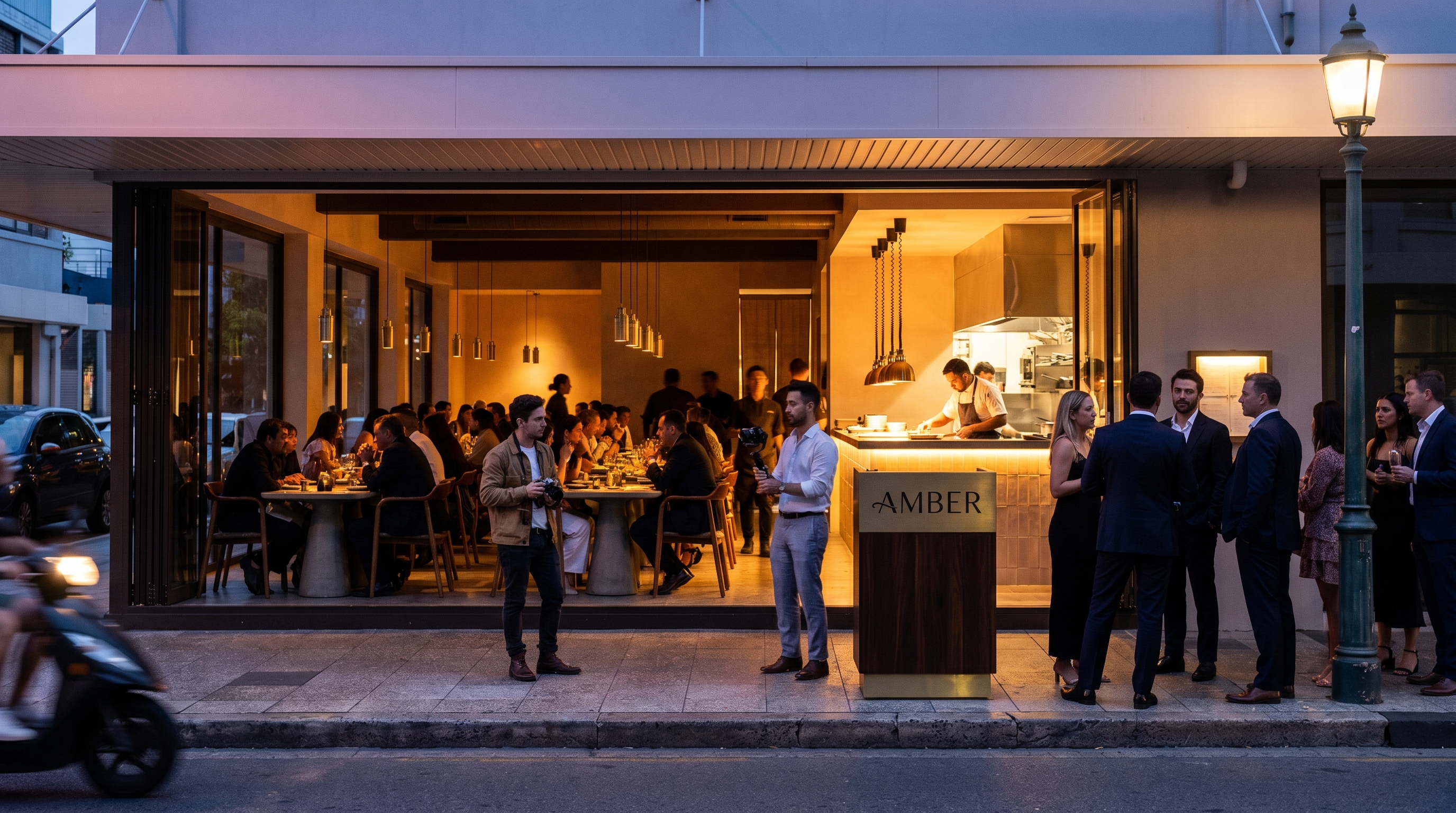
A new restaurant in Bandra opens its bookings at the start of every month. Twelve seats. Four seatings a week. Forty-eight covers, no more. The space sits one floor above its sibling, a neighbourhood Goan-Portuguese restaurant the chef helped build. There was no opening party in the conventional sense. No paid Curly Tales feature on day one. No paparazzi at the door.
The waitlist is the marketing.
The room is Papa's. The chef is Hussain Shahzad, who trained at Eleven Madison Park in New York under the late Floyd Cardoz, founder-chef of the Hunger Inc. group that built The Bombay Canteen and O Pedro. Papa's is named for Cardoz. It opened in February 2024 and within a year had been written into the extended list of Asia's 50 Best Restaurants.
It got there without the playbook that worked for ten years in this country.
That line, from the operator who built Social and Smoke House Deli into the country's biggest casual-dining brand, is the working thesis of every launch conversation in India right now. Building it has not become more expensive. Filling it has become more difficult. The unit of launch has shrunk from the campaign to the cohort. The first thousand customers of any new Indian restaurant or hotel in 2026 are cultivated, named, in WhatsApp groups and Instagram DMs and the press lists the founder has personally tended for years. They are not bought.
This is how that change happened, and what works in its place.
The three waves
The Indian hospitality launch playbook has rewritten itself three times in fifteen years.
The 2010-2015 wave was press, traditional advertising and the opening party. The headline launch of the era was The Bombay Canteen in February 2015. Floyd Cardoz was back from Top Chef Masters and Le Bernardin; Sameer Seth and Yash Bhanage ran the operating company; Thomas Zacharias built a modern-Indian menu that effectively created the category as a press object. Modern-Indian as a magazine column did not exist in Mumbai before The Bombay Canteen. The restaurant didn't open into a category. It published the category by opening.
The 2016-2021 wave was Instagram, influencers and chef PR. The cleanest case is Goila Butter Chicken, which began life as a Mumbai pop-up while Saransh Goila was on Sanjeev Kapoor's Food Food channel. Two friends started the #GoilaButterChicken hashtag. The hashtag trended. The trend pulled the kitchen into existence. Goila opened the first delivery store in Andheri in 2016 because, in his own line, "the tribe became so big that I was not able to keep up. It felt like I was doing a disservice by not launching this." By the end of the wave, the brand had a hundred stores across forty Indian cities. Twitter had preceded the restaurant.
The 2022-2026 wave is creators, exclusivity and community. Papa's is the restaurant-side proof. Kapil Chopra's The Postcard Hotel — though it opened in 2018 — is the boutique-hotel proof that the new playbook is at least eight years old when the operator already knows what they are doing. Brij Hotels is the proof that the playbook scales: 22 boutique properties in five years, ending with a controlling-stake acquisition by IHCL.
The new wave shares a shape. Smaller. Slower. More personal. The audience the founder used to rent from a broadcaster or a publisher now belongs to the founder directly — through a feed, a podcast, a WhatsApp channel, a counter of twelve seats.
Three anchors
Scarcity as the marketing — Papa's and Benne, Mumbai
Papa's is almost impossible to get into. The booking model produces a structural waiting list. Slots open at the start of the month. Four seatings a week when Shahzad is present. Twelve seats per service. The press call isn't "we are open." It's "this is the only week of the month you might get in." Outlook Traveller, ELLE, Homegrown and The Print all wrote launch features about the access itself, treating the scarcity as the news.
The economics make this work. A 12-seat counter doesn't need 30,000 customers in year one. It needs a couple of thousand of the right ones. The press tier required to fill those seats is small and well-cultivated. Hunger Inc.'s existing relationships with food media, built across The Bombay Canteen, O Pedro and Bombay Sweet Shop, were the launch infrastructure that the counter inherited the day it opened.
The other version of the same mechanic is Benne. Where Papa's manufactures scarcity by limiting seats to twelve and bookings to once a month, Benne refuses reservations altogether. The brand opened in May 2024 as a 250-square-foot Darshini-style counter in Pali Hill, Bandra — Bengaluru-style benne dosa, podi idlis, filter coffee, prices a fraction of fine-dining. Within weeks the line was around the block. Two years on, Benne has crossed the sea-link to Girgaon Chowpatty (its largest outlet, 4,400 sq ft, opened March 2026), added a Juhu location, and is opening in Delhi. None of them take reservations. Deepika Padukone and Ranveer Singh were the first visitors at the Chowpatty opening. Virat Kohli has been photographed in the queue.
The queue is the marketing. Every person walking past the original Pali Hill shopfront on a Saturday afternoon sees the line and learns what the place is worth. The photograph of the celebrity in the same queue tells the same story at scale on Instagram. Benne is the proof that the principle Papa's runs on at three thousand five hundred rupees a cover also runs at two hundred and fifty rupees a dosa.
Scarcity is the product, whether it's manufactured by booking systems or by physical line. The diner doesn't pay only for the food. They pay for the relative impossibility of being among the people eating it. The first thousand customers become the first thousand evangelists, because each one walks out with a story they will tell.
The manifesto as marketing — Kapil Chopra, The Postcard Hotel
Kapil Chopra spent fourteen years at The Oberoi Group, the last several as its president. When he opened the first three properties of The Postcard Hotel — Velha, Moira and Cuelim, all in Goa, all between six and twelve rooms — in 2018, he had something most first-time hoteliers do not. He had the standing to refuse.
The Postcard's positioning is a set of negative rules. No buffets. No fixed meal times. No sugary welcome drinks. Rooms between 800 and 1,950 square feet at properties small enough that the staff knows every guest by name within a day. Each rule reads as a deliberate refusal of the industry standard.
The refusals became the press hook. Every Condé Nast Traveller India or Hotelier India profile of the brand leads with what The Postcard does not do. Each rule is a column in itself. The Booking.com brand score sits at 9.6, the highest globally for a luxury hotel chain, because the manifesto is also the product. Guests who choose The Postcard aren't the residual demand for whatever the chains down the road are selling. They are a positively selected cohort.
A boutique brand cannot afford to compete on the floor — thread count, butler service, chauffeur transfers, marble bathrooms. The Postcard doesn't try. It competes on the ceiling by writing it.
The rolling launch — Brij Hotels
Udit and Anant Kumar — fourth-generation hoteliers, great-grandchildren of Babu Brijpal Das Ji — founded Brij Hotels in 2021 with a $4 million Series A from Ranjan Pai's Manipal Group. Five years later they run 22 properties with eleven more in the pipeline. In late 2025, IHCL acquired a 51% controlling stake for roughly ₹222 crore, an outright validation of the boutique-experiential thesis the chain market had been watching from the sidelines.
What's worth studying isn't the destination, it's the engine. Brij turned each opening into its own discrete press cycle. Bhowali in Nainital. Dharamshala. Pokhara. Mulshi. Raipur Fort. Lucknow. Eleven more coming. Where The Postcard launches once and asks the press to come back, Brij launches twelve times and asks the press to come each time. The geography itself becomes a renewable PR asset — every new property a fresh angle, a fresh local story, a fresh set of regional travel writers brought in.
The cohort is built the same way Papa's builds it, but spread across a footprint. By the time the IHCL deal closed, Brij had a press network in every Indian metro and a guest list that had walked through eleven different versions of the brand. The acquisition wasn't an exit. It was the chain market admitting that the boutique founder had cracked something the chain operating manual hadn't.
The tactics, in practice
Within those three patterns, the operator's working playbook breaks into a tighter set of moves.
Early evangelists. The friends-and-family cohort is no longer optional. It is the founder's most reliable acquisition channel and the only one with infinite ROAS. Hunger Inc.'s food-press relationships, cultivated across a decade of restaurants, were the reason Papa's opened to a waitlist. SUJÁN's 25-year conservation press — Tatler 101 Best Hotels in 2001 and again in 2024, Condé Nast Traveller's Gold List in 2025 — is the same story slowed down to a quarter century. A new restaurant in 2026 that hasn't talked to ten food writers before opening day is opening blind.
Influencers, stratified. The Indian food and travel influencer ecosystem has split cleanly into tiers. Kamiya Jani's Curly Tales is the macro-publisher tier, with roughly 4.5 million YouTube subscribers and a feature schedule that operates like the food section of a national daily once did. The mid-tier — Mumbai Foodie, Eating Out Bombay, Delhi Food Walks, Bangalore Foodie — is the workhorse layer most launches buy. The micro tier (five to fifty thousand followers, ₹3,000-₹15,000 a collaboration in metros, sometimes a meal in lieu of cash) carries engagement rates of four to eight per cent against one to two per cent at the celebrity end. A single performing reel from a credible local food page can lift reservations roughly thirty per cent in a week.
Design as the bridge. Sequel BKC, when it opened in 2023, was photographed by Design Anthology, ELLE Decor and Design Pataki before the food press arrived. Ashiesh Shah's Atelier had built a Wabi-Sabi room with a hand-crafted Channapatna-bead lighting installation and a terracotta-brick floor. The design press wrote the room. The food press followed. Diners came for the interior and stayed for Vanika Choudhary's menu. Bombay Sweet Shop is the same idea at retail: Sneha Dasgupta's illustration system on every box and label, Studio LAB's typographic Byculla storefront. Every product leaving the counter is a permanent visual activation.
Exclusivity and the drop. Papa's twelve seats. The Postcard's six-room properties. Soka in Bengaluru running omakase-style cocktail journeys against a 38-seat bar. The mechanic is identical. Manufacture difficulty of access, then sell the access.
Discovery: Google, Zomato, Magicpin. This is the unsexy half of the modern launch, and the one most boutique operators under-invest in until they're already open. A new restaurant in India is functionally invisible until its Google Business Profile is verified, its photos uploaded, its reservation link live, its menu searchable, and its first thirty reviews on Zomato and Magicpin are positive. Zomato Pro and Magicpin promotional placement are the modern equivalent of a quarter-page newspaper ad — paid distribution to a high-intent audience already opening the app to decide where to eat. A Mumbai or Bengaluru restaurant with a four-plus Zomato rating and a thousand reviews has effectively earned the floor of acquisition. Below that, no amount of Curly Tales coverage closes the gap. For hotels the layer is OTAs — Booking.com, MakeMyTrip, Agoda — plus Google Hotels and Tripadvisor. The Postcard's 9.6 Booking.com brand score is not an accident. It is the result of a discipline most properties don't put in.
Celebrity and the paparazzi photograph. Shilpa Shetty's Bastian in Mumbai operates partly as Bollywood's default new-restaurant backdrop. Every opening from the Bastian Hospitality group — INKA at Lower Parel (Peruvian-Asian under chef Kinyo Rodas Tristan), Ammakai for Mangalorean, Bastian at Juhu — becomes a paparazzi event before it becomes a press event. Viral Bhayani's lens is, for a certain tier of Mumbai restaurant, more valuable than a column in the Sunday paper. The press release writes itself in Page 3 the next morning.
The chef-podcast circuit. A founder appearance on Founder Thesis, The Seen and the Unseen or The Ken's First Principles now functions roughly the way an Outlook Business cover did fifteen years ago. The audience is smaller — but it is exactly the right people. Kapil Chopra's First Principles appearance, Sameer Seth and Yash Bhanage's Harper's Bazaar India ten-year retrospective on The Bombay Canteen, the founder LinkedIn essays that Indian hoteliers and restaurateurs are now writing in earnest — each one moves a measurable cohort of bookings within a week.
The first thousand
The honest first-thousand math for a hospitality launch in India in 2026 is unflattering and clarifying in equal measure.
A 12-seat fine-dining counter like Papa's runs roughly 2,400 covers a year at full booking — the first 1,000 covers arrive in the first five months. Those covers are roughly forty per cent food-press evangelists and their friends, thirty per cent operator's-own-network referrals, twenty per cent first-month walk-ins from the existing Hunger Inc. customer base, and ten per cent genuine cold discovery via Instagram and Zomato listing.
A 6-room boutique hotel like a single Postcard property does roughly 1,800 room-nights a year at 80% occupancy. The first 1,000 stayers arrive over the first seven months and come predominantly from Booking.com (the platform's discovery surface for a 9.6-rated property is brutal in the operator's favour), the founder's press list, and word-of-mouth from a small but well-distributed early-guest cohort.
A 100-cover restaurant in a Mumbai metro neighbourhood has a different shape — first 1,000 customers in roughly six weeks if the launch executed cleanly. The mix tilts toward walk-in (Bandra and Indiranagar foot traffic is its own marketing surface), Zomato discovery, and Reels-led visits.
Across all three shapes, the pattern holds. Paid acquisition that scales — Zomato Pro pushes, Google search ads, Meta lead generation — becomes economically interesting somewhere around customer 1,001. Before that point, the cost per customer of broad paid acquisition is higher than the founder's own time spent personally cultivating a hundred press, influencer and operator relationships.
What this means for the operator
Three working rules, for anyone opening this year or next.
Build the cohort before the room. The founder's personal network — the food writers they've stayed in touch with, the influencers they actually know, the WhatsApp groups they actually post in — is the launch infrastructure. Six to twelve months of talking like the brand before opening is no longer a luxury. It is the channel.
Manufacture difficulty. The Indian consumer in 2026 is over-supplied with new options. Scarcity is the most reliable way to make a new option feel necessary. Twelve seats, six rooms, a Friday-only drop, a waitlist with a real reason — not a fake one — outperforms every campaign that promises abundance.
Take Google, Zomato and Magicpin seriously. The discovery surfaces matter more than the magazine feature. A four-plus rating with a thousand reviews is a permanent acquisition asset. A Curly Tales feature is a one-week spike. Build both. Front-load the boring one.
The room takes six months to build. The cohort takes longer.
If you're hiring a chef, a captain, a bar manager, a front-office team or a brigade for a new room in 2026 — Kaam Hire is the platform we built for it. Pre-vetted, ladder-classified, ready to go on a Saturday.
Sources & references 13
- Papa's — Hunger Inc. press
- Benne Dosa Chowpatty opening — Time Out Mumbai
- Benne Delhi expansion — Curly Tales
- The Postcard Hotel — Hotelier India
- Kapil Chopra on First Principles podcast
- IHCL acquires 51% in Brij Hotels
- Brij Hotels — Hospitality Biz India
- Goila Butter Chicken — Esquire India
- Riyaaz Amlani — Business Today
- The Bombay Canteen — Harper's Bazaar India
- Sequel BKC — Design Anthology
- NRAI IFSR 2024 — Restaurant India
- Asia's 50 Best 2025 — Outlook Traveller
Kaam Hire is a hospitality-first subscription ATS. 275,000+ pre-classified candidates, AI-matched shortlists, public shareable job pages. ₹1,499/month.
Try Kaam Hire