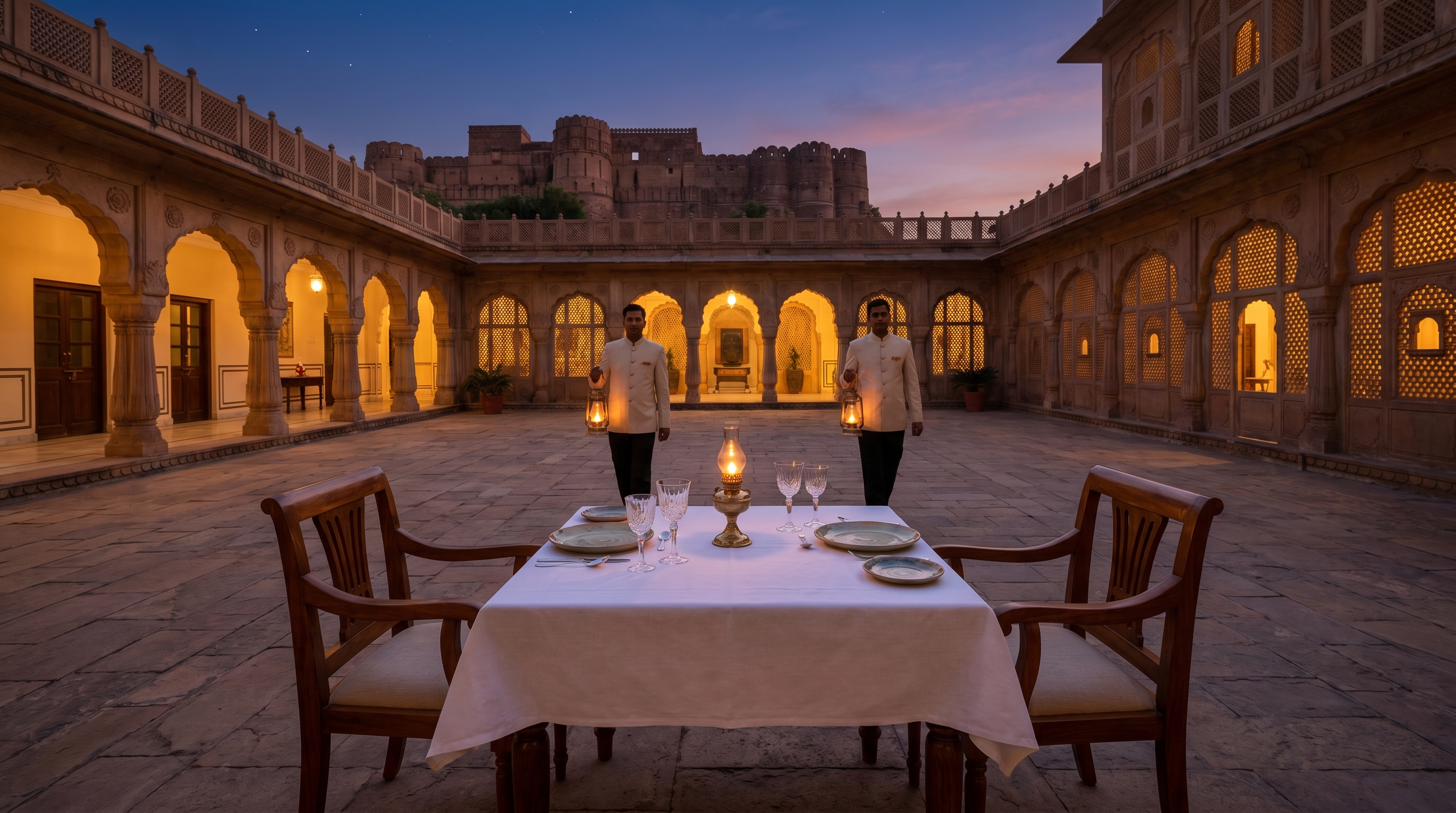
The luxury hotel in India has hit a problem it didn't have ten years ago. Thread count, butler service, chauffeured airport pickup, marble bathrooms with rainfall showers — at the top of the market, all of it has become the price of entry. Not the proposition. The floor.
That floor is being held, with varying success, by the historic Indian chains — Taj, Oberoi, Leela. The proposition, the thing customers are now paying genuinely more for, has moved somewhere else. The hotels that are growing fastest in the country aren't selling rooms anymore. They're selling time, story, and stillness — and the numbers say the customer is paying differently for each.
India's luxury and upper-upscale segment posted an average daily rate of ₹13,379 in 2025, up 8.7 per cent year on year. The Den in Bengaluru lifted ADR by 25 per cent in a single year on flat occupancy. India's UHNW population is projected to grow over fifty per cent by 2028. The wealth is here. It is just spending differently.
The no-buffet rule
The cleanest articulation of the new doctrine comes from Kapil Chopra, former President of The Oberoi Group, who founded The Postcard Hotel in 2018 and has built the brand around a set of explicit refusals. No buffets. No fixed meal times. No children under fourteen at most properties. Rooms run between 800 and 1,950 square feet. Properties at Velha in Old Goa, Saligao village (five rooms), Cuelim overlooking 3,500 acres of paddy — each one small enough that the team knows every guest's name by Saturday afternoon.
The Postcard isn't competing with the chains. It's competing with the guest's own house. The brand promise is functional: the hotel does for you what your house cannot. Not the room — the time. Breakfast cooks when you wake up, not when the kitchen opens. No-one drags you out of dinner because the dining room shuts at ten.
The category Chopra invented in India is now its own tier. Brij Hotels — founded in 2021 by Udit and Anant Kumar, great-grandchildren of Babu Brijpal Das Ji — runs twenty-two properties and eleven more in the pipeline, on a $4 million Series A. "We cherish the simple pleasures and moments of joy that may often be overlooked," says Anant Kumar. "Such as the feeling of walking on grass." That isn't marketing copy. It's the working brief.
Twenty-five years of one bet
The other answer to the same question is older, slower, and harder to copy. Jaisal Singh was twenty-one when he opened Sher Bagh at Ranthambhore with his wife Anjali. The room count was small. The bet was conservation. Twenty-five years later, SUJÁN runs four properties — Sher Bagh at Ranthambhore, JAWAI in the leopard country of Pali, The Serai at Jaisalmer, and Rajmahal Palace in Jaipur — and the conservation thesis has held all the way through.
Eighty per cent of the team is hired from the immediate region. The group runs free primary healthcare for 25,000 people across the villages around its properties and has adopted thirteen schools. JAWAI's wildlife guides — the ones who walk guests out to track leopards in the granite outcrops above the village — are former poachers, retrained.
This is not a marketing line. It is a multi-generation business decision. The reason guests return to SUJÁN at the rate they do is not the linen or the food, though both are very good. It is the moral simplicity of a hospitality business that pays its conservation bills out of its room nights. The luxury industry has spent twenty years calling sustainability a value-add. SUJÁN has spent twenty-five treating it as the product.
The wellness destination
The third move is the most extreme. Six Senses Vana in Dehradun is the brand's first dedicated wellness retreat globally — not a hotel with a spa attached. Twenty-one acres of sal forest. The medical anchor combines Ayurveda, Tibetan Sowa-Rigpa (approved by the Dalai Lama's medical school), Yoga and Natural Therapies. The programmes start at five nights for Sleep, Detox, Yoga, Weight, Ayurveda or Tibetan Medicine, and run up to a twenty-one-night Panchakarma.
And then there's the rule that defines the place. Phones are not allowed outside the guest rooms. The lobby is silent. The dining room is silent in a way no chain hotel will ever be — there is nothing for anyone to be on a call about. The retreat is not a spa break. It is a clinical intervention dressed in beautiful Himalayan architecture.
The pattern across the experience-led tier is the same. Aman-i-Khás at the edge of Ranthambhore runs an astronomer-led "cosmic safari" with an 8-inch Dobsonian telescope — one-hour sessions guarantee four to six celestial objects. Ananda in the Himalayas programmes weekly sound baths and a dedicated Vedic Mantra and Sound Healing Retreat anchored in Swami Parthasarathy's Bhagavad Gita translations. Wildflower Hall, an Oberoi Resort at Shimla, runs its spa in private therapy cabins set inside the cedar forest — restricted to resident guests only. That single rule, spa for residents only, is the policy that tells you what the category has become.
The wedding economy quietly rerouting
The same shift is happening in the wedding business, with the same direction of travel. The heritage-palace category — RAAS Devigarh on the Aravallis, Samode Palace outside Jaipur, Neemrana Fort at Alwar — is taking the high-spend destination-wedding share back from the chain ballrooms. The reason is simple. The venue is the experience. The 500-guest sangeet in a 475-year-old palace courtyard doesn't need a theme. The palace is the theme.
The destination-wedding-as-mini-festival model — Goa beach club for the welcome, fort for the sangeet, palace for the reception — has separated cleanly from the 5-star ballroom in a way the chains cannot easily reverse. The wedding planner who used to book one hotel for the full event now coordinates three different venues for three different nights of a single wedding.
The operating economics
Three things matter for an operator looking at this category from the inside.
ADR is higher and growing faster at the experience-led tier — the 8.7 per cent year-on-year national figure is being pulled up disproportionately by the boutique top end. Repeat-stay rates run above sixty per cent at the strongest properties, against fifteen to twenty-five per cent typical for the chains. And per-guest revenue from in-house experiences — every forest bathing session, sound bath, cooking class, plantation safari — is a paid line item that the buffet-and-spa hotel model does not carry.
The trade-off is operating intensity. A property cooking 80 per cent organic, anytime-breakfast for six to fourteen rooms staffs very differently from a 150-key hotel running a 200-cover buffet. The hire profile shifts toward generalists — a butler who is also a guide and a cooking teacher. The wage ladder bunches at a higher entry point with fewer ranks above it. The kitchen brigade is smaller, but each cook earns more.
Sustainability has stopped being marketing. IHCL's Paathya programme, under MD & CEO Puneet Chhatwal, has codified a 2030 commitment to single-use-plastic-free operations, on-site organic-waste systems at every hotel, full wastewater recycling, fifty per cent renewable energy, and the skilling of 100,000 youth. Taj Cidade de Goa became the first IHCL hotel to earn Green Key certification in 2025. The chain that owns the floor is racing to catch up to the boutique tier that defined the new ceiling.
What's coming next
Three trend lines visible from here.
Wellness becomes the new luxury, full stop. India's wellness tourism market is $27.92 billion in 2025, projected to reach $38.22 billion by 2030. Ayurveda is still the anchor. Longevity retreats — Panchakarma plus genomic medicine plus stem-cell rejuvenation — are being packaged for the global health-span traveller, with India as the destination.
Spiritual hubs are the next experiential frontier. FHRAI is tracking 300-plus premium properties planned for Rishikesh, Ayodhya, Tirupati and Bodh Gaya. The Postcard / SUJÁN / Aman playbook is moving into temple towns. The boutique heritage hotel and the spiritual retreat will be the same product in three years' time.
Regenerative tourism. Eco-resorts focused on plastic elimination, community welfare and biodiversity stewardship — the SUJÁN and Paathya models — are becoming table stakes for the next generation of luxury launches. Not optional. Not a marketing chapter. The product itself.
The luxury floor is being held by the people who built it. The luxury ceiling is being rewritten by the people who never wanted to compete on thread count in the first place.
Thread count is the floor. Everything above it is the new India luxury. The operator question for 2026 isn't how to compete with a five-star — it's whether you're competing on amenity or experience. The market is paying differently for each.
Sources & references 7
Kaam Hire is the hospitality-only hiring platform that powers this blog. If hiring is on your mind — try it.