The Hospitality Sector Skill Council's own published estimate is that India needs roughly 3.8 lakh trained hospitality professionals every year. The IHM system produces approximately 30,000 hotel-management graduates. Even if every graduate joined a restaurant or hotel, which they don't, the supply would cover under eight per cent of the demand.
Every operator in this country has met the gap with some combination of three responses: recruit harder, train internally, or accept lower bars and live with the consequences. The brands that have built durable hospitality businesses in India have all done some version of the same thing — they have stopped pretending the market will train their staff for them.
The IHM funnel is too narrow, and pointing in the wrong direction
IHM Pusa Delhi reported a 97.42% placement rate in 2024, average package ₹5 lakh per annum, highest ₹8.43 lakh, with eighty-one recruiters on campus including Taj, Hyatt, Hilton, Dunkin, IndiGo and Aditya Birla Fashion Retail. IHM Mumbai and IHM Bangalore sit at roughly 80% placement and ₹3-4 lakh averages.
These are not bad numbers for the graduates. They are a structural problem for standalone restaurants. The top of the supply pipe — Pusa, WGSHA Manipal, IHM Bangalore — flows mostly to airlines, cruise lines, hotel front office, QSR management training and the Gulf. A Pusa graduate offered ₹18,000 per month as a commis-3 in a five-star kitchen, after a three-year course costing the family ₹1.5 to 3 lakh, takes the IndiGo offer instead.
Meanwhile a non-graduate from a Bihar or Odisha hospitality skill centre, willing to accept ₹14,000 with food and stay, does the same work on the same line, with no certification but a faster ramp on station-specific tasks. The standalone restaurant industry has been quietly running on the second pipe for a decade. Most operators don't say this out loud.
The Welcomgroup Graduate School of Hotel Administration in Manipal, founded in 1986 as an ITC-Manipal joint venture, is ranked forty-sixth globally by CEOWORLD, and requires thirty weeks of on-job training at Fortune or ITC hotels in its curriculum. This is what a well-built pipe looks like — university, on-job, guaranteed conversion. There are not enough such pipes.
The brands that win all build their own academy
The Oberoi STEP — a three-year residential apprenticeship partnered with IGNOU, providing housing, meals, uniforms, insurance and a monthly stipend, with guaranteed Operations Assistant offers on completion — is the gold standard. The two-year Oberoi Centre for Learning and Development post-graduate programme is, by general industry consensus, the single most coveted hospitality fast-track in India.
IHCL has built a parallel structure through its skilling partnership with the CII and the Lausanne-based Ecole hôtelière (EHL). The eighteen-month diploma combines classroom work with on-job training at IHCL hotels, and the programme has trained 28,000 youths across fifty-one centres in twenty states, with a target of 100,000 by 2030.
Westlife Foodworld — McDonald's franchisee for West and South India — sends store managers to Hamburger University in Chicago or Hong Kong, and runs a domestic "learn while you earn" partnership with Welingkar School of Management. KFC India became the first global QSR to train all 17,000+ frontline employees in sign language. These are not feel-good initiatives. They are recruitment moats. The brands have built a reason for the best people to apply to them and not the place down the road.
On the standalone side, Olive Bar & Kitchen under AD Singh, and Indian Accent under Manish Mehrotra in the pre-MMCA years, functioned as informal academies. Chefs left after three or four years to open their own kitchens. That alumni network is the single best brand marketing those restaurants still have. Massive Restaurants under Zorawar Kalra has talked publicly about empowering staff "to grow beyond their titles", and the cross-training discipline that requires.
The source mix has flipped — and most operators are still hiring like it's 2018
Pre-COVID, the typical Indian restaurant's source mix looked roughly like this: referrals 50%, walk-ins 20%, IHM and catering schools 15%, job boards 10%, agencies 5%.
In 2026, the same mix in metros looks closer to: referrals 30%, gig platforms 25-30%, hospitality-specific platforms 10-15%, IHM and catering schools 5-10% (mostly captain and manager roles, very little entering the cook line), walk-ins 15% (and dying as rent migration pushes the local labour pool to the urban edges), and agencies 5-10%.
The gig platforms — Apna with its fifty-million-candidate pool, Vahan.ai with its 2.6 lakh placements across 920 cities in 2024, BetterPlace, WorkIndia, plus emerging hospitality-vertical platforms — have taken twenty to thirty per cent of frontline hires almost without operators realising it. The brands that already use these channels have a structural cost-per-hire advantage of 30 to 50% over the brands still relying on walk-ins and newspaper inserts.
For a new restaurant opening, total staffing setup runs ₹1.5 to 5 lakh, with a 60-90 day lead time. The single most under-priced channel inside that spend, in our reading of the data, is the employee-referral programme. A ₹500 bonus at thirty days and a ₹1,500 bonus at ninety days, on a successful joiner who completes both windows, beats almost any agency or job-board fee. The referred staff member is also statistically more likely to survive the first ninety-day attrition cliff.
Hire for shift discipline, not CV
McDonald's Station Observation Checklists are useful to study even if you're nowhere near McDonald's scale. Each station — grill, fry, beverages, drive-thru, front counter — has a defined set of certifications. A crew member is "certified" on a station when they hit consistent standard, not when they have been "trained" on it. The certifications are visible: badges, names on a wall chart, named crew trainers who hold the standard.
This translates badly into a fine-dining context if you import it literally. It translates well if you take the principle: behaviour at a specific task, demonstrated repeatedly, beats any CV claim. A commis who's run the saucier station for a senior chef three times under pressure is worth more, on day one of your kitchen, than a commis with an IHM Bangalore certificate and a five-month restaurant exposure.
This works for floor staff too. A captain who can run a guest interaction without managerial backup, take an order on a 22-cover Saturday section without losing a ticket, and close out a complex table-pay request, is the captain you want. The interview is the wrong place to find this. The first thirty days of probation, with measurable shift outputs, is where it's actually visible.
The skill gaps employers actually complain about
The Ministry of Tourism's Skill Gap Study and Hotelier India's recurring reporting converge on the same answer: the bottleneck is soft skills, not technical skills.
Specifically: aptitude and attitude, English and French fluency (the latter for fine-dining service), grooming and personal presentation, guest interaction beyond script, upselling without aggression, hygiene knowledge beyond surface compliance, and the ability to recover gracefully from a service mistake.
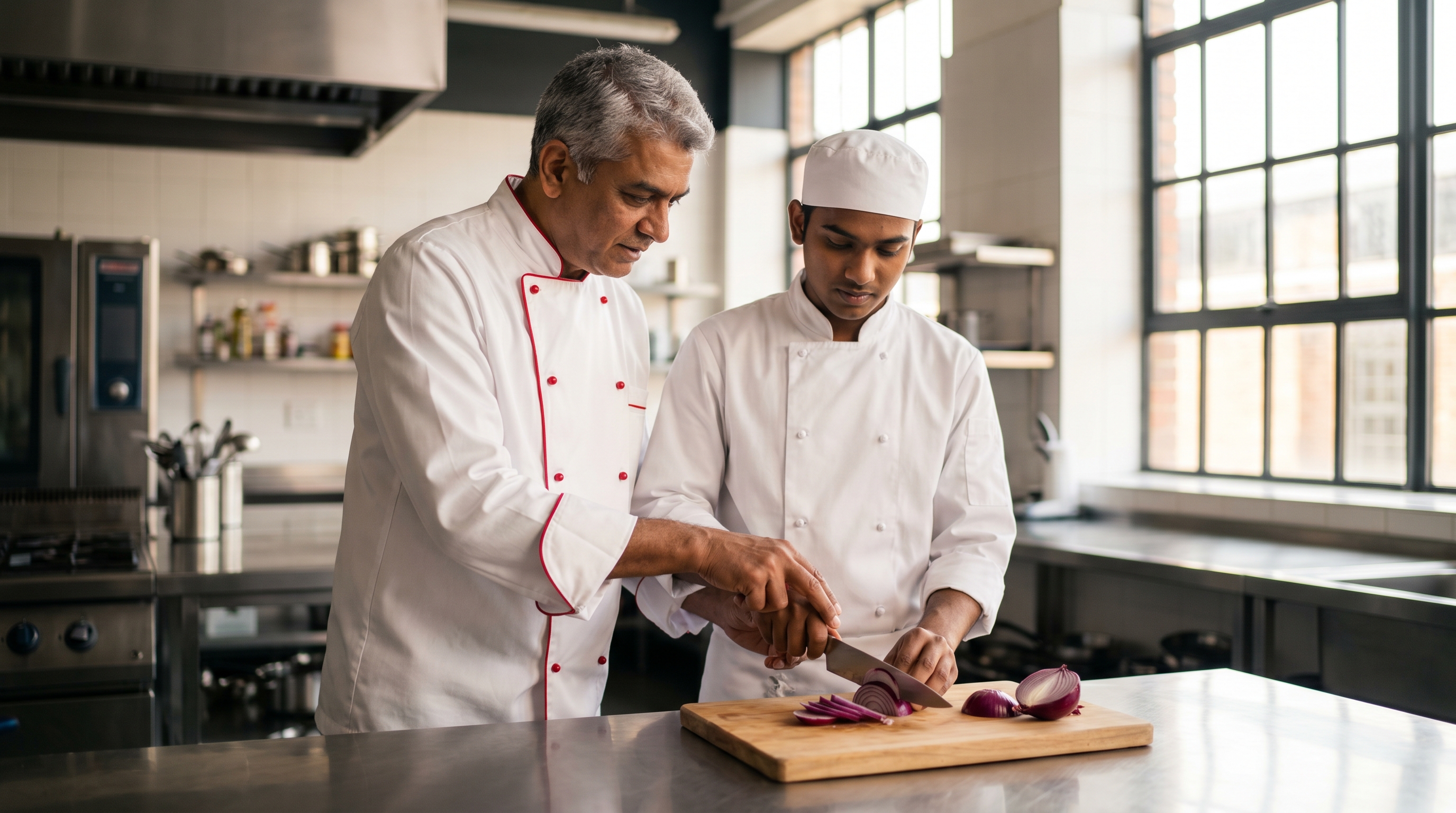
Notice what is not on the list: knife skills, basic kitchen production, mise-en-place discipline, point-of-sale operation. Those are teachable in two to four weeks. The soft skills take twelve to eighteen months of sustained mentorship, and they are exactly the skills the four-month government certification schemes cannot deliver.
What a working hiring engine looks like
Six elements, in operational order, that show up across the brands that retain staff:
- A named recruiter. Not a function. A person. Floor staff applying to your restaurant should know whose desk their CV lands on, what the next step is, and when to expect a call. The single most under-priced lever in Indian hospitality hiring is responsiveness.
- A clear hiring brief, written down, role by role. Most operators improvise the JD every time they need to fill a role. The first hire is fast; by the fifth, the brief has drifted, and the standard is now whoever happened to walk in. Write the brief once.
- A standardised interview script for each tier. Three questions for crew, six for commis, ten for CDP, twelve for captain, twenty for manager. The script doesn't constrain the conversation; it makes the conversations comparable across candidates.
- A working pre-employment trial. Two to five days on the floor, paid at the daily prorated rate, with an explicit "we will let you know in 48 hours" close. This catches the ninety per cent of misalignments that interviews miss.
- A first-thirty-days plan. Day-by-day for the first week, week-by-week for the first month, with named mentors and clear competency milestones. Most attrition happens in the first ninety days. Most of it can be prevented in the first thirty.
- An exit interview that asks real questions. Did you feel safe? Did anyone humiliate you in front of a guest? Did you understand your salary slip? The answers tell you what's actually broken in your operation.
None of this is glamorous. All of it is uneven across the industry. The brands that do all six retain their best staff. The brands that do none of them spend their lives recruiting.
The training that compounds
The best training programmes in Indian hospitality are not the most expensive ones. They are the most consistent ones. A daily fifteen-minute pre-service briefing, run for two years without a break, transforms a kitchen more than any annual three-day off-site. A monthly cuisine workshop, where one cook teaches the brigade a regional preparation they grew up with, builds both repertoire and dignity. A quarterly cross-functional rotation — captains spending two shifts a year in the kitchen, cooks spending one a year on the floor — produces managers who actually understand the business.
The brands that compound are the ones that have built training as a habit, not a programme. The brigade learns because the senior chef teaches every day, in five-minute fragments, between covers. The captain learns because the floor manager debriefs every difficult guest interaction at end-of-shift, not at the next annual review.
This is not novel. It is not even expensive. It is, in most kitchens, simply not done.
Sources & references 8
- IHM Pusa 2024 placements
- Oberoi STEP programme
- Tata.com — IHCL × CII × EHL skilling 28,000 trained
- Welcomgroup Graduate School of Hotel Administration
- Westlife Foodworld — Investing in our People
- Ministry of Tourism Skill Gap Final Report
- Business Standard — Anjan Chatterjee on trained manpower
- APN News — Vahan.ai 2.6 lakh blue-collar placements
Kaam Hire is a hospitality-first subscription ATS. 275,000+ pre-classified candidates, AI-matched shortlists, public shareable job pages. ₹1,499/month.
Try Kaam Hire