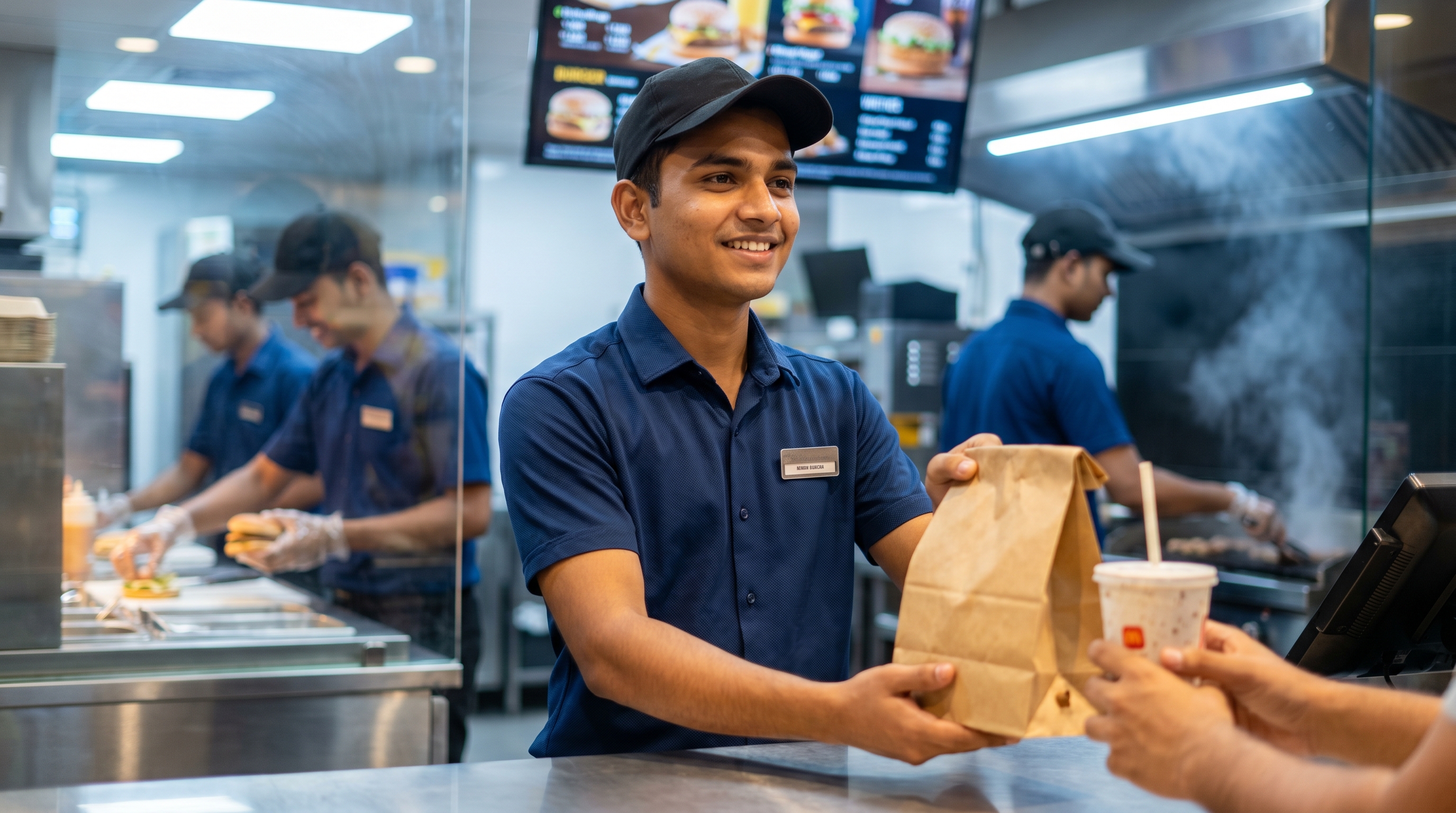
Domino's India added 81 stores in a single quarter of FY26. At an average of fifteen people per store across crew, supervisors and managers, that is roughly 1,200 new hires every ninety days, for one brand. The numbers across the rest of the listed Indian QSR universe are similar in scale.
Hiring is not an HR function for a QSR operator. It is a permanent production line. The brands that built a working hiring engine in 2018-2020 are the ones still expanding profitably in 2026. The brands that improvise are still posting "store opening soon" banners six weeks past their planned launch date.
The scale you're hiring against
The five operators that define Indian QSR scale:
- Domino's India (Jubilant FoodWorks) ended Q2 FY26 with 2,321 stores in India and a group network of 3,594 stores across six markets. The corporate workforce is approximately 445, but the operating footprint employs over 30,000 people.
- Westlife Foodworld runs 450 McDonald's restaurants across 72 cities in West and South India as of September 2025, opening 45-60 new restaurants annually, targeting 580-630 outlets and ₹4,000-4,500 crore in revenue by 2027.
- Devyani International ended FY26 with 2,256 system-wide stores (KFC, Pizza Hut, Costa). KFC is the growth engine; Pizza Hut expansion is paused through CY2026.
- Sapphire Foods closed FY26 at 1,052 stores (KFC, Pizza Hut, Taco Bell) across India, Sri Lanka and Maldives. The Sapphire-Devyani merger talks could consolidate the Indian Yum! franchise universe.
- Burger King India (Restaurant Brands Asia) hit 513 Burger King stores and 464 BK Cafe formats at FY25 close, adding 58 in 12 months, targeting 800 BK stores by FY29.
Add the homegrown chains — Wow Momo at 850+ outlets across 90+ cities and 200 net adds in FY26, Burger Singh at 180+ stores targeting 1,000 by 2030, Subway India at 900+ stores adding 100+ in FY26, Theobroma at 225+ outlets after the ₹2,410 crore ChrysCapital deal in July 2025 — and the hiring volume across the segment runs into the low six figures every year.
The role structure you are actually hiring for
A typical full-format Indian QSR — McDonald's, KFC, Domino's with dine-in plus drive-thru — runs with 25 to 40 people across all shifts. The shape is consistent across brands:
- Store manager (1 per store): owns the P&L, the people, the operating standards, the local community. Compensation ₹35,000-65,000 per month plus quarterly performance bonus.
- Shift supervisors / shift leads (2-4 per store): each shift has one on the floor. ₹22,000-28,000 per month, sometimes with a per-shift incentive.
- Crew trainers (1-3 per store): certified to onboard new joiners on specific stations. ₹16,000-20,000.
- Crew members — front counter and drive-thru (3-6 per store): order taking, POS, drive-thru speed. ₹14,000-18,000.
- Crew members — kitchen (4-8 per store): grill, fry, prep, beverages, dispatch. ₹14,000-18,000.
- Packaging crew (1-2 in high-volume stores): a real role at delivery-heavy outlets, not a side duty.
- Delivery rider arrangement (2-6, often attached via aggregator or operated as direct hire): typically gig-platform managed.
A small QSR — momo express, single-format burger outlet, neighbourhood Subway — runs 4 to 8 crew plus a manager. A high-volume metro McDonald's or KFC runs the full 30-to-40 headcount split across two shifts.
The crew-to-shift-supervisor ratio is the right indicator of operational health. Below 1:4, the supervisor is doing crew work and missing standards. Above 1:8, the crew is unsupervised on the floor at peak. The right band is 1:5 to 1:6.
The wage and incentive reality
The TeamLease 2024 QSR study put 88% of frontline crew in the ₹15,000-20,000 monthly band, 12% below ₹15,000, and 64% receiving no incentive component at all. The 64% figure is the one to fix first. A crew member on a fixed-only salary, with no weekly incentive, will leave faster than a crew member on a smaller fixed plus a clear bonus on a single measurable metric.
The metrics that work, depending on station:
- Drive-thru: order-to-window time. Sub-90-second target.
- Front counter: average order value. A ₹15-25 bump per ticket via consistent upselling is worth a daily bonus band.
- Kitchen: prep-time-to-order, food cost variance.
- Cross-cutting: mystery shopper score (now standardised across most national chains).
The brands that retain crew the longest pay a smaller fixed plus a meaningful weekly incentive on one metric. The brands that lose crew fastest pay a flat fixed and call the extra hours "discipline".
The hiring funnel that actually works
The 2025-26 source mix at well-run Indian QSR operators looks roughly like this, in order of cost-effectiveness:
- Employee referrals. Still the highest-quality channel. A ₹500 bonus at 30 days plus ₹1,500 at 90 days on the referrer, paid on successful retention, is the single best deal in QSR hiring. Referred crew survive the 90-day cliff at much higher rates.
- Walk-ins at the store. Dying in central metros (rent migration has emptied the local labour pool), still healthy in tier-2 and tier-3. A "we're hiring" board outside the store, kept fresh, is worth more than a hiring agency relationship.
- Blue-collar gig platforms. Apna (50 million-plus candidate pool, subscription-based for employers), Vahan.ai (2.6 lakh placements across 920 cities in 2024, WhatsApp chatbot-driven, Persol Group invested 2025), BetterPlace, WorkIndia, SalaryBox. These are now structural channels, not experiments.
- Hospitality-vertical platforms. Newer, faster, classified to role level. Increasingly used for crew trainer and shift-lead hires where generalist gig platforms don't deliver enough signal.
- ITI and hospitality skilling institute tie-ups. Slower but yields better quality at the crew-trainer level. Most national chains run a formal partnership with at least three institutes in their core operating cities.
- Walk-in job mela / job fairs. Useful for pre-opening crunches. Mass-walk-in days where 80-150 candidates show up at the new store and the hiring team converts 30 on the day.
The 19% monthly attrition reality
The BetterPlace Frontline Index FY22 measured monthly QSR turnover at 19% — meaning nearly one in five frontline employees rotates out every month. The H1 FY23-H1 FY24 figure is broadly the same at 19.3%. Three-quarters of the QSR workforce serves under three years; 36% leave within 24 months.
These numbers should not be approached as a recruitment problem. They are a churn-cost problem. Every replacement hire costs an operator the recruiter time, the training time, the productivity ramp of the new joiner (typically 30 to 60 days before they're at full output), and the customer-impact cost of a less-experienced crew member on the floor.
The brands that have moved their crew attrition from 19% monthly to 12-14% monthly have done four things:
- Restructured wages to include a weekly variable component on one clear metric.
- Made the internal growth ladder visible — crew to crew trainer in 4-6 months on competency, crew trainer to shift supervisor in 12-18 months. Names of the people who made it, on the staff notice board.
- Honored statutory compliance in full. ESIC, PF, gratuity, statutory bonus. Most operators are surprised how much of their attrition is people leaving for "a place that gives me PF in writing".
- Built a 30-day onboarding plan with named crew trainer, daily competency check-ins, and a Day-30 review where the new joiner is told plainly what they've nailed and what needs work.
McDonald's Station Observation Checklists — borrow the principle, not the format
The McDonald's training architecture is worth studying even if you're nowhere near their scale. Each station — grill, fry, beverages, drive-thru, front counter — has its own Station Observation Checklist. A crew member is "certified" on a station when they hit the standard consistently, not when they have been "trained" on it. The certifications are visible: badges, names on a wall, named crew trainers who hold the standard.
The point isn't to import the McDonald's SOP. The point is the principle: behaviour at a specific task, demonstrated repeatedly, beats general experience claims. A crew member who can be trusted to hit a 60-second drive-thru three days in a row is worth more than a crew member with "two years QSR experience" listed on a CV.
The brands that implemented station-based certification — even informally, on a single laminated sheet pinned in the back office — saw two things change. The crew started caring about their own progress, because progress was visible. And the supervisors started managing to a standard, because the standard was now objective.
The COCO vs FOFO vs COFO model — and why it matters for hiring
Approximately 70% of Indian QSR expansion now runs on FOFO — franchise-owned, franchise-operated. The franchisee carries the payroll, owns the local hiring, and absorbs the attrition. In COCO stores (corporate-owned, corporate-operated) the brand HR machine does it centrally. COFO sits in between — franchisee owns the property, the brand operates.
For anyone designing a hiring playbook, this matters: a FOFO operator makes hiring decisions in WhatsApp. The franchisee writes the cheque, signs off in 24 hours, and replaces a crew member by Friday because Saturday is the day a McAloo Tikki burger gets sold every 18 seconds. A COCO HQ runs an RFP, lines up approvals, takes 21 days to fill the same role.
Hiring tools that pretend the brand HQ buys for the FOFO franchisee lose. Hiring tools that work directly with the franchisee, on WhatsApp speed, win.
The pre-opening crunch — 30 hires in 14 days
This is the test of any QSR hiring engine. A new store opens in four to six weeks from lease signing. The crew, supervisors, manager and trainers need to be on the floor, trained, certified and shift-ready by Day Minus 7. The number is 25 to 40 hires, depending on format.
The playbook that consistently delivers:
- Week 1 (Day -42 to Day -35): Manager and shift supervisors hired from internal transfers or existing brand alumni. These are the spine of the new store. No compromise on the manager hire.
- Week 2 (Day -35 to Day -28): Job boards live across Apna, Vahan, BetterPlace. Referral programme announced at sister stores with a ₹2,000 bonus per successful joiner. Local WhatsApp groups activated.
- Week 3 (Day -28 to Day -21): Two open-house walk-in days at the upcoming store location, advertised on Instagram local pages, regional language flyers in the catchment. Target 80-120 candidates across both days.
- Week 4 (Day -21 to Day -14): Interviews and pre-employment trials. Selected crew start unpaid orientation. Training shifts at the nearest sister store begin.
- Week 5 (Day -14 to Day -7): Full training shifts at the new store with senior trainers from sister stores. Stations certified, one by one. Manager runs final readiness check.
- Week 6 (Day -7 to Day 0): Soft launch with full crew. Real ticket volume. Sister-store trainers stay on for the first weekend.
Brands that have done this dozens of times run it like clockwork. Brands doing it for the first time consistently fall two weeks behind. The difference is not the people. It is whether someone has written down what each day looks like.
Sources & references 8
- Jubilant FoodWorks — Domino's India company profile
- Outlook Business — Westlife McDonald's expansion plan
- Storyboard18 — Devyani pauses Pizza Hut expansion
- Indian Retailer — Burger King India FY29 800-store target
- HR-Katha — QSR workforce 75% under 3 years
- BetterPlace Frontline Index FY22
- APN News — Vahan.ai 2.6 lakh placements
- Prism News — McDonald's Hamburger University blended training
Kaam Hire is a hospitality-first subscription ATS. 275,000+ pre-classified candidates, AI-matched shortlists, public shareable job pages. ₹1,499/month.
Try Kaam Hire