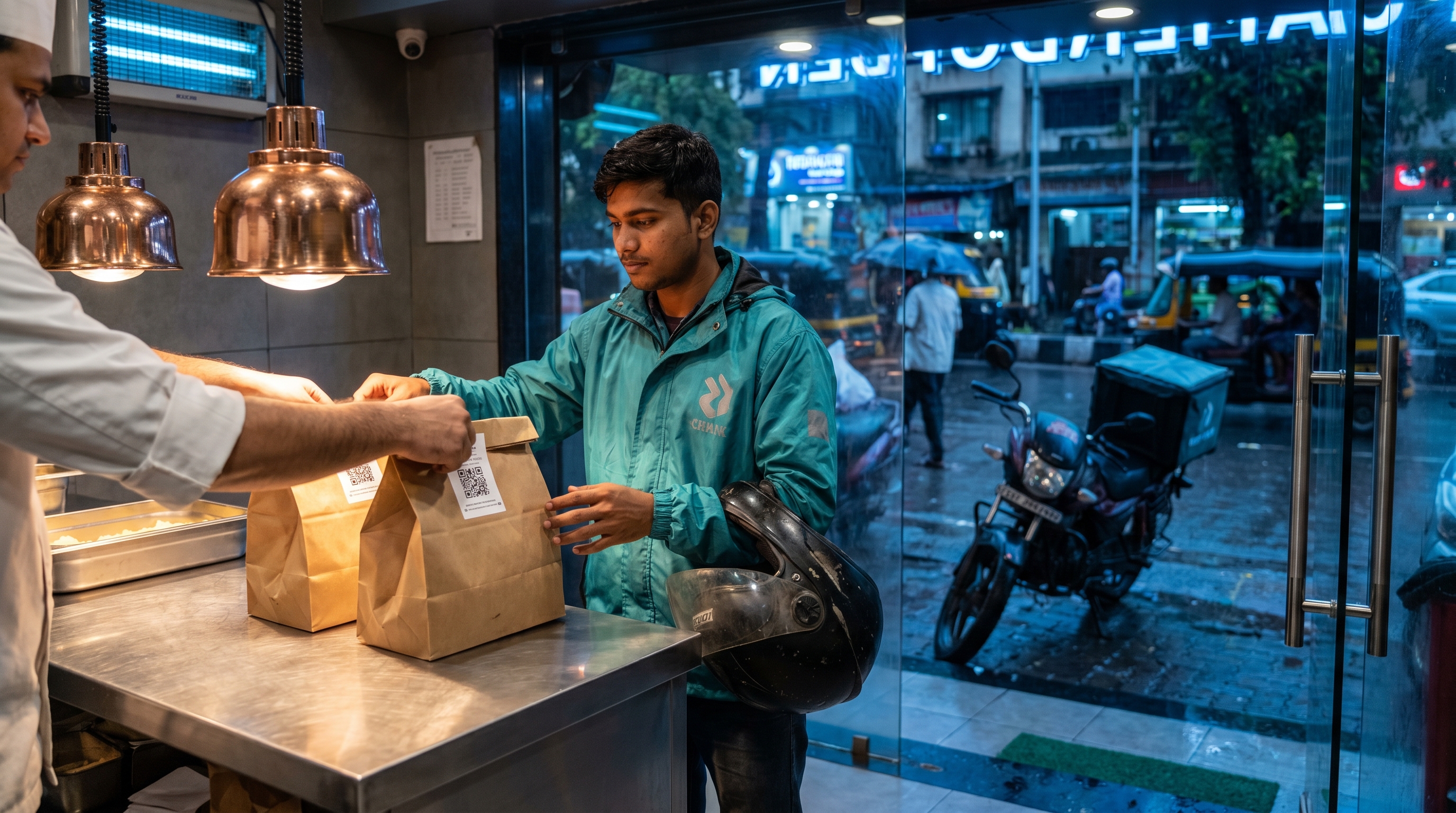
The first thing every operator should understand about listing a restaurant on Swiggy or Zomato is the size of the wedge. Base commission on both platforms sits in the 18-25% band — Zomato around 25%, Swiggy around 24% headline. Negotiated outliers can drop to 15% for high-volume chains or climb past 30% with promotional bundles.
That is not the number to plan against. The total take, once everything stacks, lands at 25-35% of order value: base commission, plus the ₹17.58 per-order platform fee both platforms hiked to in March 2026, plus the 1.9-2% payment-gateway fee, plus 18% GST on the platform's service and payment fees, plus the 0.1% TDS under Section 194-O, plus packaging spread, plus the new long-distance delivery fees Zomato introduced in July 2025 (₹20 for 4-6 km orders, ₹40 for 6+ km).
The implications for menu pricing, staffing, and the day-to-day operating discipline of a delivery-heavy kitchen are large and mostly under-discussed. This is what the working playbook looks like in 2026.
What the platforms actually require to onboard you
The paperwork is non-negotiable on both sides:
- FSSAI licence. Basic if annual turnover is under ₹12 lakh, State for ₹12 lakh to ₹20 crore, Central beyond ₹20 crore. The number must appear on your menu, packaging, and listing page.
- GST registration. Required regardless of turnover when you list on an aggregator (the platforms collect TCS under Section 52 of the GST Act).
- PAN of the owner / business entity.
- A cancelled cheque or bank account proof for payment settlement.
- Menu PDF with category-wise listing, prices, and a clear vegetarian / non-vegetarian / contains-egg indicator on every item.
- Photographs. Hero photos for at least the top-selling 8 to 12 items, plus a restaurant exterior or kitchen shot.
- Shop and Establishment registration under your state's labour rules.
- Trade licence from your local municipal corporation.
- For delivery operations specifically: confirmation of operating address, prep-time commitment per category, and packaging spec.
Onboarding timelines: Zomato review typically 3 to 7 working days, Swiggy verification 3 to 7 days, and the listing goes live 7 to 10 business days end-to-end on each platform. Both platforms now offer mobile-first onboarding (10-15 minutes for self-serve setup) plus an assigned account manager for operators above a revenue threshold.
Photography is operational, not cosmetic
Zomato's premium onboarding package includes a Hyperpure-affiliated photo shoot of up to 20 images, capped at a 2-hour shoot, to be completed within 45 days of going live. The platform's own PicNic AI tool upgrades restaurant-supplied photos to platform standard. Restaurants with high-quality photos see significantly more orders.
The reason is mechanical, not aesthetic. The app's tile placement and search-result ranking weight photo quality and menu-description completeness as signals. A poorly-lit smartphone photo of a dish, alongside a one-line menu description, gets less algorithmic placement than a well-lit shot with a 30-40 word description that mentions cuisine, key ingredients, and portion size. The difference shows up in week-three orders, not on day one.
For operators not on the Zomato premium photo path, the alternative is a half-day shoot with a local food photographer, ₹15,000 to ₹35,000 depending on city and dish count. The ROI on that single spend is the highest-leverage investment in the first 90 days of a new listing.
The rating algorithm is the silent co-owner of your business
A single rating dip below 4.0 can move a restaurant off page one of search results. Restaurants at 4.2 and above dominate top placement. The algorithm weights the last 20 to 30 reviews disproportionately. Zomato actively penalises review solicitation — a "please rate us" sticker on the packaging can trigger a direct rating hit, not just review removal, and a "suspicious reviews" warning banner on the listing.
The defensible play is operational, not promotional:
- Respond to every negative review within 24 hours, by name, with a specific resolution offer.
- Run a 4.0-trigger SOP: if the live rating drops below 4.1, dispatch a mystery shopper within 48 hours. If "spilled" appears in two reviews in a week, audit the packaging line that day. If "cold" appears twice in a week, audit prep-time and dispatch SLA.
- Treat the rating as a leading indicator that the line is breaking down, not as a marketing problem.
The most experienced delivery operators in India check their rating dashboard the way old-school restaurateurs checked the reservations book: every morning before the brigade arrives, with someone accountable.
Prep time, dispatch SLA, and the 30-minute promise
The 30-minute delivery promise the platforms make to the customer translates into a 10-12 minute prep-time SLA for the restaurant. Anything beyond that means the rider is waiting at the pickup counter, the order is going cold, and the customer rating is about to take a hit.
Cloud kitchens audit dispatch SLA daily. The dashboard has three numbers that matter: average prep time, prep-time outliers (the orders that took 18+ minutes), and order-rejection rate. High rejection rate (the restaurant cancelling an accepted order) is the single fastest way to lose visibility. The platforms reduce rank-eligibility for restaurants with rejection rates above 3-5%.
The implications for kitchen layout, equipment, and staffing are direct. A kitchen built for sit-down service, where a dish takes 15-18 minutes from KOT to pass, does not survive on Swiggy or Zomato without restructuring. The brands that successfully run dual dine-in plus delivery have either physically separated the prep-line for delivery items, or sequenced their menu so that the highest-velocity delivery items are pre-prep'd to a state where final assembly takes under 8 minutes.
Packaging is a real cost line
Packaging costs ₹5 to ₹15 per order at most operators, and the aggregators charge restaurants approximately ₹2 per order more than they pass to packaging suppliers — that wedge alone is roughly ₹400 crore of ecosystem revenue annually.
Beyond cost, packaging is the single biggest determinant of the customer experience your kitchen does not get to see directly. A biryani that arrives with leaked gravy is a one-star review no matter what the food tasted like. A pizza that arrives in a box too small loses two stars. The packaging spec — material, food-grade certification, leak-resistance, branding — is operational infrastructure, not marketing collateral.
The serious operators have moved to: heat-sealed container lids for any curry-based dish, brown kraft outer bags with handwritten order numbers (cheap, durable, perceived as artisan), and an explicit "we don't pack for delivery" exclusion list (anything that goes soggy: dosas, fried items without a vent, ice-based desserts).
Staffing a delivery-heavy kitchen is different from staffing a dine-in kitchen
The roles that emerge as distinct, only at delivery-led volume:
- Packaging crew. One person for a 100-200 orders-per-day operation, two for higher volume. This is not a side duty for an existing kitchen helper. Mis-packaging is the source of 30-40% of low-rating reviews; a dedicated crew member catches issues a multi-tasking helper misses.
- Dispatch coordinator. Owns rider hand-off, the OTP exchange, the order-number verification, and the rejection triage if a rider doesn't show up. At above 250 orders a day, this is a full-time role on at least one shift.
- Phone handler. Owns the refund and complaint resolution loop. Usually the shift supervisor; in larger kitchens, a dedicated person.
- The kitchen line itself. Cooks split between dine-in prep (if applicable) and delivery prep (fast, repeatable, packaging-optimised). The KOT routing system needs to separate dine-in and delivery tickets so prep doesn't collide at the pass.
The dine-in-heavy brands that successfully run delivery as a second business — Theobroma, La Pino'z, Pizza Hut, Wow Momo — all run two physical workflows in one kitchen, with KOT routing splits, separate dispatch counters, and dedicated packaging stations. The brands that try to run delivery as a side function of the dine-in kitchen consistently miss SLAs.
Direct channels — the only path to a sub-10% commission line
The aggregator commission isn't negotiable; the aggregator dependency is. The serious chains in India in 2026 are running a dual stack — Swiggy/Zomato for reach, plus a direct-order layer for margin.
The options worth evaluating:
- ONDC is now live across major Indian cities by mid-2025 with a 2-7% commission cap, plus government subsidies of ₹100-150 crore announced for buyer apps like Magicpin, Paytm, Ola Consumer and Waayu. The user experience is still uneven, but the direction is clear.
- Petpooja serves 150,000+ outlets and provides a native online-ordering layer that lets the restaurant own the customer.
- DotPe and Rista offer similar layers with closer integration to WhatsApp and direct payment flows.
- Rapido launched food delivery in 2025 with an 8-15% commission undercut. The breadth and rider density are still building, but it is the first credible third pillar in years.
- WhatsApp catalogue ordering is now native enough for menu listing, image, price and order capture. Most small restaurants haven't activated it yet. The setup is a one-time 90-minute job.
The strategic target most operators we work with set: 20-30% of total delivery revenue from direct channels within 12 months. The 3-5 percentage points of EBITDA that brand can claw back from aggregator commissions is, for most kitchens, the difference between profitable and break-even.
What to do about negative reviews
Real, defensible, in this order:
- Respond within 24 hours, by name, specifically. A generic apology is worse than no response. If the review says "the biryani was cold", say "I'm sorry your Hyderabadi dum biryani arrived cold on the 12th of May — the dispatch from our kitchen was on time but the rider waited 6 minutes for the lift; I've reached out to the platform separately. Please write to me directly at owner@restaurant.com and I'd like to send you a fresh order on the house."
- Track patterns weekly, not daily. If three reviews in a week mention the same dish, the dish has a problem. If three reviews in a week mention the same time-of-day, the shift has a problem. The pattern matters more than the individual review.
- Ignore the obvious review-farm cases. Zomato actively flags them. Reporting them through the platform's official channel is faster and cleaner than responding publicly. Do both.
- Build a "review responder of the day" rotation at the management level. The shift supervisor on duty responds to every review that comes in during their shift, end-of-shift. This makes the response timely and gives the supervisor visibility on what's actually going wrong.
The case studies worth studying
- Wow Momo — hub-and-spoke kitchen model, hundreds of express outlets with central-commissary supply. Decouples delivery prep from in-store production.
- Theobroma — refused aggregator delivery for years to protect product quality, then onboarded selectively. Per-store delivery share remains below industry norm. Strategy: dine-in margin protects the brand; delivery is supplementary, not foundational.
- La Pino'z — delivery-first with small footprints and packaging-optimised pizzas. Survived the aggregator commission squeeze because the model was built for it.
- Pizza Hut India (Devyani's franchise) — the cautionary tale. Same-store sales fell, expansion paused for CY2026, partly because the delivery economics didn't recover the dine-in shortfall.
The conclusion across all four: the question is never whether to be on Swiggy and Zomato. It is what percentage of your revenue you can afford to let the duopoly own. Below 60% is a healthy ratio. Above 80% is dependency. Above 90% means your business model isn't yours; it's theirs.
Sources & references 8
- Spice Advisors — Swiggy vs Zomato commission structure 2025
- Menu Manager 2026 — Zomato & Swiggy commission breakdown
- Outlook Money — Hidden food-delivery costs
- Medianama — Zomato long-distance delivery fees (July 2025)
- Zomato blog — Dish Magic photography programme
- RestroMark — How the Zomato algorithm works
- Business Standard — Rapido undercuts food delivery commission
- Outlook Business — ONDC food delivery subsidies
Kaam Hire is a hospitality-first subscription ATS. 275,000+ pre-classified candidates, AI-matched shortlists, public shareable job pages. ₹1,499/month.
Try Kaam Hire