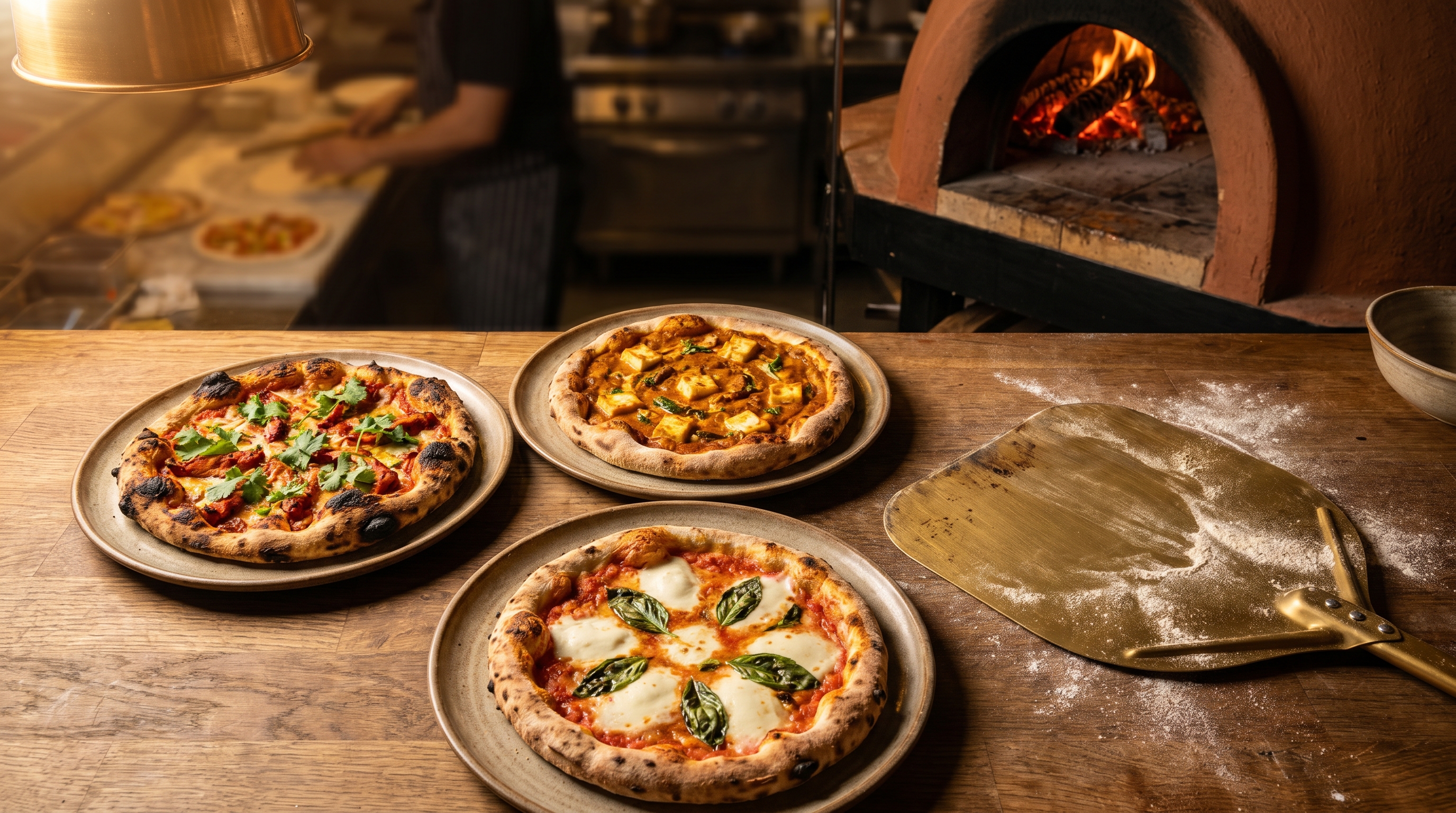
On 18 June 1996, India's first Pizza Hut opened in Bangalore under police protection. Karnataka State Farmers' Association activists had ransacked the city's KFC outlet earlier that year, and PepsiCo — which then owned both brands — wasn't taking chances. The store opened anyway. Domino's followed in Delhi the same year.
Thirty years on, the same country eats more Domino's pizza than any nation on earth except the home market. The chain crossed 2,000 Indian stores in June 2024 — the first country outside the United States to do so — and is heading toward four thousand within the decade.
The pizza box has become a more reliable indicator of an Indian neighbourhood's middle-class density than the streetlight.
But the more interesting story isn't the conveyor. It's what happened underneath it.
The translation
The first thing the American chains had to do, before the pizza could scale, was to make peace with the Indian tongue. The Domino's product team — working out of Noida, twenty minutes from any neighbourhood that hadn't yet seen a pizza — built a parallel range alongside the imported Margherita and Pepperoni. Paneer Tikka. Indi Tandoori Paneer. Chicken Butter Masala. Peppy Paneer.
This wasn't fusion. Fusion is what restaurants do when they're trying to be clever. This was translation. The product team didn't put Indian food on a pizza. They taught the pizza to speak Hindi.
The veg-non-veg menu architecture — the colour-coded green dot, the colour-coded red dot — encoded the politics of the household onto the box. For most of the chain's Indian history, vegetarian orders dominated. The most recent market data has only just nudged non-vegetarian ahead, and only among under-30 urban consumers. Most Indian operators today still build their menus 50/50. The growth tilt is non-veg. The base is not.
The masala pizza became its own genre. The country that learned to eat Domino's didn't learn to eat American pizza. It learned to eat the version of pizza that Domino's wrote for it.
The quiet revolution
Sometime around 2015 — fifteen years after the chains had finished the work of normalising pizza — a different conversation began. A generation that had eaten proper Naples-style pizza in proper Naples-style rooms in London, New York and Bangkok came home and wanted it here. For a long time, that wasn't really possible. Imported mozzarella came frozen. Italian flour came expensive. The wood-fired oven in a Mumbai kitchen mostly produced soggy crusts.
The unlock, when it came, was domestic. Indian dairies — the Pune Mozzarella Factory, The Spotted Cow Fromagerie — began making fresh buffalo mozzarella in volumes that could feed a real pizzeria. 00 flour became importable at scale. The economics of a 90-second 450°C bake stopped being a fantasy.
The clearest expression of the wave is Pizzeria da Susy in Gurugram. Susanna Di Cosimo, Naples-born, came to India in 2013 to run a travel company. When the pandemic took the travel business apart, she pivoted into a small pizzeria. In 2025 — four years after opening — she became Pizza Maker of the Year at the Ferrarelle Award, and her room became India's first entry on the 50 Top Pizza World list, at #35.
It is the kind of story Indian fine dining used to be allergic to. A woman with no formal culinary training, doing one dish well, in a mall in Gurugram, beating fine-dining rooms on a global list.
The other end of the same wave is Si Nonna's, founded in Mumbai in 2022 by Ayush Jatia, whose family holds the McDonald's franchise for West and North India. Si Nonna's runs a sourdough starter traced back five hundred years to Naples, and became India's first AVPN-certified pizzeria — the Associazione Verace Pizza Napoletana grants that mark to fewer than a thousand rooms in the world. Three years on, the brand operates more than thirty-five locations across eight Indian cities.
One story is a single perfect room. The other is the same idea, systematised. Between them, they explain why the Indian pizza category is no longer one thing.
The kit, briefly
A credible Neapolitan pizzeria needs three things and a person.
The oven, which has to get past 430°C. The dough, which has to ferment for at least twenty-four hours, cold. The cheese, which now finally exists in India, fresh. And the pizzaiolo, who has to know how to stretch a ball by hand — a Neapolitan crust is hand-stretched, non-negotiable; the sheeter is for New York and Roman.
Everything else is detail. The total kit for a 40-cover Neapolitan place — one deck, one spiral mixer, one cold-prep table, peels, an infrared thermometer — sits in the fifteen-to-thirty-five lakh range. A QSR-grade conveyor setup is a different machine entirely and a different business entirely.
The economics work because pizza is the rare restaurant format with a single hero SKU, high gross margin and a short cook time. A Neapolitan pie is on the table in three minutes from order. Table turn at lunch is faster than almost any other room you can build. Food cost runs 22–28% in QSR (cheese is the heavy line) and 28–34% in artisan rooms (Caputo, San Marzano DOP, prosciutto pull the cost up). Labour is light — one pizzaiolo, one or two commis, one dough prep on an early shift mixing tomorrow's dough.
The most useful thing to know is that you cannot fake any of it. A Neapolitan pizza either cooks at 450°C or it doesn't. The mozzarella is either fresh or it's frozen. The dough either fermented or it didn't. The pizzaiolo either grew up doing this or he learned it three months ago. Customers can tell.
What's coming next
The Neapolitan baseline will be the new normal by FY27. Sourdough on the menu, which felt rare in 2020, will be unremarkable in three years. The category's next moves are already visible at the edges.
Detroit-style square pizza — higher hydration, deep-pan, with the lacy frico cheese edge that forms when mozzarella crisps against the metal — is the rising format. Roman al taglio, by-the-slice, ultra-hydrated, is appearing in airport food halls. Native-grain sourdough — buckwheat, millet, khapli wheat — is already on a few Mumbai menus and will soon be a category. Coffee roaster plus pizzeria, the same room running espresso in the morning and pizza at night, is the new unit economics for high-rent metros.
The thirty-year arc of Indian pizza is unusually clean for a food category. The first wave made it familiar. The second wave made it real. The third wave is making it ours.
A wood-fired Neapolitan pizza cooks in ninety seconds at 450°C. A Domino's pizza cooks in seven minutes on a conveyor at 280°C. They are not the same product. They are not the same business. The 2026 operator's job is to know exactly which one they're in.
Kaam Hire is the hospitality-only hiring platform that powers this blog. If hiring is on your mind — try it.