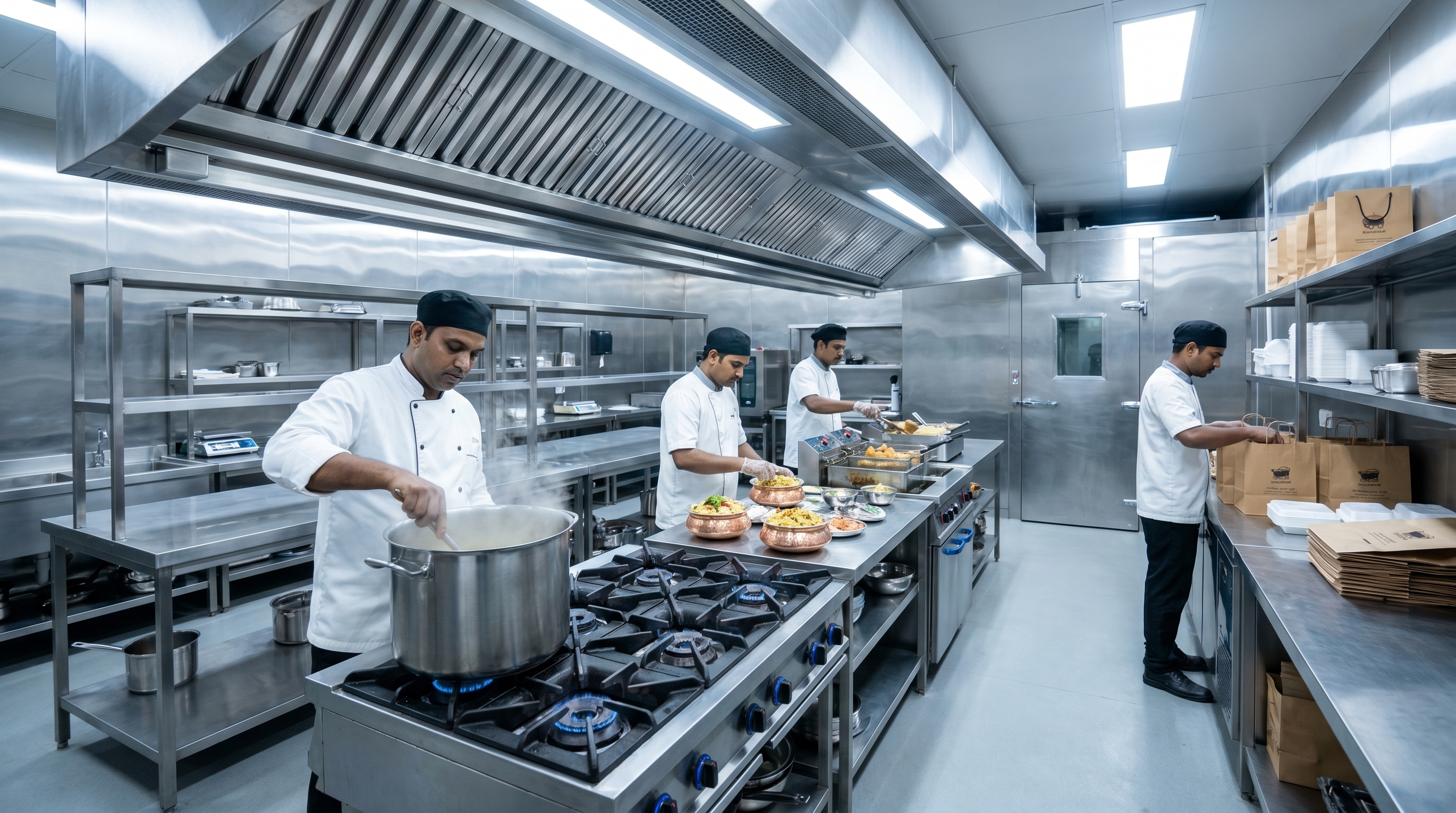
The cloud kitchen pitch sounds simple: lower rent, no front-of-house staff, no customer-facing build-out, faster breakeven. The numbers from the sector tell a different story. The NRAI's 2024 survey found that 25-30% of cloud kitchens in India shut down within their first year — and nearly half in Delhi, Mumbai and Bangalore are unprofitable.
The cloud kitchen model isn't bad. The version of it most first-time operators build is bad. Twelve things to factor in before you sign a lease.
The capex band is wider than people admit
A bare-bones single-brand setup inside a co-kitchen facility (KaaS — kitchen-as-a-service) lands at ₹5 to ₹10 lakh. A private 300-600 sqft site with proper ventilation, drainage and a commercial electrical connection runs ₹12 to ₹20 lakh. Mid-scale single-brand kitchens run ₹12 to ₹20 lakh. Enterprise multi-brand kitchens cross ₹30 lakh. The cheapest version is a "home kitchen with FSSAI" at ₹1.5 to ₹3 lakh; the most expensive is a tech-enabled multi-brand setup at ₹40 to ₹60 lakh.
The range is wide because the value of doing it properly is largely invisible at the time of spending. A ₹2 lakh saved on the hood-and-exhaust system is the ₹4 lakh paid in temporary closure costs and rework, six months in, when the FSSAI inspector flags the inadequate ventilation. The same applies to the electrical upgrade, the grease trap, the food-safe flooring.
The itemised capex for a real 600-1000 sqft single-brand kitchen
The honest line-item breakdown:
- Kitchen equipment (range, oven, fryer, refrigeration, prep tables, tandoor, dough sheeter if needed): ₹2 to ₹6 lakh
- Hood/exhaust plus fire safety: ₹1.5 to ₹3 lakh (the line most frequently under-budgeted)
- Plumbing and electrical upgrade (3-phase, grease trap, drainage): ₹1 to ₹2.5 lakh
- Flooring and walls (epoxy or anti-skid tile, food-safe paint): ₹1 to ₹2 lakh
- POS plus KOT printers plus 4-6 tablets for aggregator apps: ₹25,000 to ₹50,000 one-time plus ongoing SaaS
- Licensing (FSSAI ₹100 to ₹2,000 base, Trade Licence, Fire NOC, GST, Pollution NOC): ₹30,000 to ₹50,000 total
- Security deposit: 3 to 6 months rent under 2025 Model Tenancy Act rules; Mumbai and Bangalore landlords still ask 6 months on commercial in practice
- Initial marketing and launch (Swiggy/Zomato ad credits, packaging, photoshoot): ₹1 to ₹3 lakh
Add a working capital reserve of 3-5 months of operating cost on top of capex. The new operators who skip this step are the new operators who close in month four.
Pay for radius, not address
Cloud kitchens live in industrial estates, mezzanines and basements at ₹40 to ₹150 per square foot, versus ₹250 to ₹500 per square foot for storefront retail. The standard hubs:
- Mumbai: Andheri East (MIDC), Goregaon (Aarey side), Powai back-lanes.
- Bangalore: HSR Sector 7, Indiranagar 100-ft side-streets, Whitefield Mahadevapura, Marathahalli.
- Delhi NCR: Gurgaon Sectors 14 and 22, Saket back-blocks, Mohan Cooperative.
The optimal customer radius is 3 to 7 kilometres from the kitchen. Beyond that, Zomato's long-distance fees — ₹20 per order for 4-6 km, ₹40 per order for 6+ km, introduced July 2025 — eat the margin on every order. The right way to evaluate a cloud kitchen lease is not "is this a good address" but "where does the 4 km circle land on the demand-density map".
Lock the location on the demand maps. The address is incidental.
KaaS — the rational entry, but it caps your upside
Kitchens-as-a-service providers — Kitchens@ ($65M Series C from Finnest, focused on India), Rebel Foods' own kitchens-as-platform, Kitopi (UAE, 200+ kitchens across 7 GCC countries, 100+ brands), and smaller players like Cloud Kitch, Smart Kitchens and Ghost Kitchens India — rent ready-to-use kitchens for ₹40,000 to ₹1,20,000 per month, including utilities.
The pros: zero capex, fast launch, shared exhaust and fire compliance, no licensing headache. The cons: revenue-share or premium rent (effectively a second commission stacked on top of Swiggy and Zomato), no asset to sell, and a structural limit on how much you can build a defensible kitchen on someone else's terms.
KaaS is the right entry point for testing a brand, validating cuisine-market fit, and building enough unit economics to justify a private site by month 9 or 12. KaaS as a permanent state caps your unit economics at about 3-4% lower margin than a comparable private kitchen.
The FSSAI and regulatory stack is cheap but exacting
FSSAI costs ₹100 to ₹2,000 a year depending on turnover band (Basic under ₹12 lakh, State ₹12 lakh to ₹20 crore, Central beyond ₹20 crore). The trap is the NOCs that adjoin it: Fire NOC, Trade Licence (municipal), Pollution NOC (state board), GST, Shops & Establishments, and in Delhi, an Eating House licence from the police. Total in practice: ₹30,000 to ₹50,000, and the paperwork takes 30 to 90 days.
The single under-rated piece of regulatory work is the Pollution NOC. State boards have tightened scrutiny on commercial kitchen exhaust since 2024, and a missing or stale Pollution NOC is the most common reason for unexpected shutdowns at the six-month mark. Get it on day one, renew on time.
Aggregator dependency is the central business problem
For most cloud-kitchen operators in India, 85-90% of revenue comes from Swiggy and Zomato. Curefoods explicitly disclosed in its DRHP that 85.6% of FY25 sales came through the two aggregators.
The total commission take per order in 2026: base commission 18-25%, plus the ₹17.58 per-order platform fee both platforms hiked to in March 2026, plus payment-gateway fee 1.9-2%, plus 18% GST on the platform's service and payment fees, plus packaging spread ₹2 per order, plus the long-distance fee ₹20-40 for orders beyond 4 km, plus 0.1% TDS. Effective leak: 25-35% of order value.
For every ₹500 order, the kitchen sees ₹325 to ₹375 in its bank account, before food cost, rent, staff and packaging. The brands that have built durable unit economics in cloud kitchens are the ones that have, from Day 1, planned for 20-30% of revenue to come from direct channels — Petpooja online ordering (50,000+ outlets), DotPe / Rista, uEngage, WhatsApp catalogue, ONDC (now live across major cities with 2-7% commission caps).
Single brand versus multi-brand — most fail by going multi too early
Rebel Foods runs eight-plus brands from a single kitchen footprint (Faasos, Behrouz Biryani, Oven Story, The Good Bowl, Lunchbox, Sweet Truth, Mandarin Oak, Slay Coffee). Curefoods runs EatFit, Sharief Bhai, CakeZone, Olio, Frozen Bottle, Iyer's Kitchen across 500+ outlets. EatClub (formerly Box8) runs Mojo Pizza, Box8, NH1 Bowls, ZAZA Mughal Biryani, LeanCrust and Mealful Rolls across 250+ kitchens.
These are operationally hard. Separate SKUs, separate packaging, separate ad budgets, but shared rent / labour / utilities. The multi-brand model rewards operators who have already industrialised single-brand operations.
The pattern across operators that fail: they launch multi-brand on day one to "spread risk", and end up running three half-built operations none of which works. The right sequence is single brand for 6-9 months until the unit economics are stable, then bolt on the second brand.
Match the food to the courier bag
The four cuisines that consistently survive 30-minute delivery economics: biryani, pizza, burgers, bowls / rolls. Everything that goes soggy (dosas, paratha, most fried items without a vent, anything with ice or whipped cream) dies on Swiggy reviews.
AOV bands by cuisine: bowls / rolls ₹250-350, biryani ₹400-600, pizza ₹450-700, desserts ₹200-400. High-AOV / low-frequency (biryani, party desserts) beats low-AOV / high-frequency on contribution margin once you net out commissions, because the per-order fixed costs (packaging, platform fee, payment fee) don't scale with the basket size.
This is one reason biryani has been the breakout cloud-kitchen cuisine of the last five years (Behrouz, Biryani By Kilo, Sharief Bhai, multiple regional players). The maths is simply kinder.
The unit economics targets a sane operator should hold to
The defensible benchmarks, from working operators:
- Gross margin (before aggregator commission): 60-70%.
- Net contribution margin (after commission, packaging, delivery fees): 18-28%.
- EBITDA target after 6 months: 8-15%.
- Daily order target to break even: 50-80 orders for a lean single-brand kitchen, 120-150 for a multi-brand.
- AOV target: ₹350-500, to keep aggregator economics workable.
Operators who haven't hit 35-40 daily orders by month four are signalling something is broken — cuisine fit, location, photography, listing optimisation, or all four. The right response is operational diagnosis, not more ad spend.
Staffing is leaner than dine-in, but more brittle
A typical single-brand cloud kitchen runs with: 1 head cook (CDP), 2-3 cooks, 2 helpers, 1 packer, 1 dispatch coordinator. Six to eight heads total. A multi-brand 1500 sqft kitchen runs 12 to 18. Most cloud kitchens operate single shift 11 AM to 11 PM, because breakfast delivery in India is still small. Twenty-four/seven only makes sense for biryani or late-night brands in Bangalore or Gurgaon.
Brittleness is the issue. A six-person kitchen with one cook out sick on a 120-order Saturday is a kitchen that's missing 35% of orders or running an 18-minute prep time. Either outcome destroys ratings for two weeks afterward. The cloud kitchens that retain ratings consistently keep a "floater" arrangement with one or two on-call helpers in the same building or nearby — usually a kitchen-helper pool sourced through informal referral chains.
Marketing is paid visibility on the aggregator, not Instagram
Organic Instagram for cloud kitchens almost never moves the needle, because there is no storefront walk-by, no in-person discovery, no incidental brand impression. Influencer micro-deals (one-time food-in-exchange) work for a two-week spike, but they don't compound.
The marketing that works is paid placement on the aggregator: Swiggy Premium listings, Zomato Pro placements, "₹125 off above ₹249" funded coupons. 15-20% of revenue on platform ads is normal for the first three months, dropping to 8-12% as repeat-customer rate builds.
The single highest-leverage non-ad activity in months 1-3 is review responsiveness. Every five-star review responded to with a personalised thank-you compounds. Every three-star review acknowledged with a specific recovery action compounds. Operators who think marketing is the Instagram reel are the operators stuck below 80 orders a day at month nine.
Descriptive cuisine names — the brand-naming pattern that consistently wins
Look at the cloud-kitchen brands that have actually broken out: Behrouz Biryani (premium biryani), Oven Story (pizza), Sweet Truth (cakes), Mojo Pizza (large pizza, value), EatFit (healthy), Sharief Bhai (heritage Bangalore biryani), Biryani By Kilo (biryani, premium), Box8 (the bowl box).
Notice the pattern. Almost no one has built a serious cloud-kitchen brand on an abstract, non-descriptive name. The reason is mechanical: the cloud-kitchen consumer searches by cuisine on Swiggy and Zomato. The search query is "biryani near me", not the name of an evocative brand. A brand name that telegraphs the dish in two words gets the click. A brand name that has to be explained doesn't.
This is one of the biggest mistakes new operators make. Months are spent on a clever brand name that means nothing on the search bar. The cuisine name and the brand name should be inseparable in the customer's first read.
The closing checklist
Before signing the lease:
- Have you mapped the 4 km demand circle from the proposed location?
- Have you priced the full capex including a 5-month working capital reserve?
- Do you have written quotations for the hood/exhaust, electrical, plumbing, and food-safe build-out?
- Have you secured the FSSAI, Trade Licence, Fire NOC, and Pollution NOC paperwork timeline?
- Have you decided on single-brand vs multi-brand, with a defensible reason?
- Have you stress-tested the cuisine on a 30-minute delivery — packed, transported, opened, tasted?
- Have you costed packaging at ₹5-15 per order across your top SKUs?
- Do you have a Day-1 plan for direct-channel acquisition (Petpooja, DotPe, ONDC, WhatsApp catalogue) alongside the aggregator listing?
- Have you budgeted 15-20% of revenue for platform ads in months 1-3?
- Have you written a review-response SOP and named the person who owns it?
If any of these is "we'll figure it out later" — don't sign the lease yet.
Kaam Hire is the hospitality-only hiring platform behind this blog.
Sources & references 7
- Restroworks — Cloud Kitchen Cost in India
- Skope Kitchens — Cloud Kitchen Business Model
- Kouzina — Cloud Kitchen Investment Insights India
- Inc42 — Cloud kitchen math, economics of foodtech
- Medianama — Curefoods SEBI ₹800 cr IPO approval
- BBFT — Rise and Fall of Cloud Kitchens India
- IBEF — Cloud Kitchen Industry India
Kaam Hire is the hospitality-only hiring platform that powers this blog. If hiring is on your mind — try it.