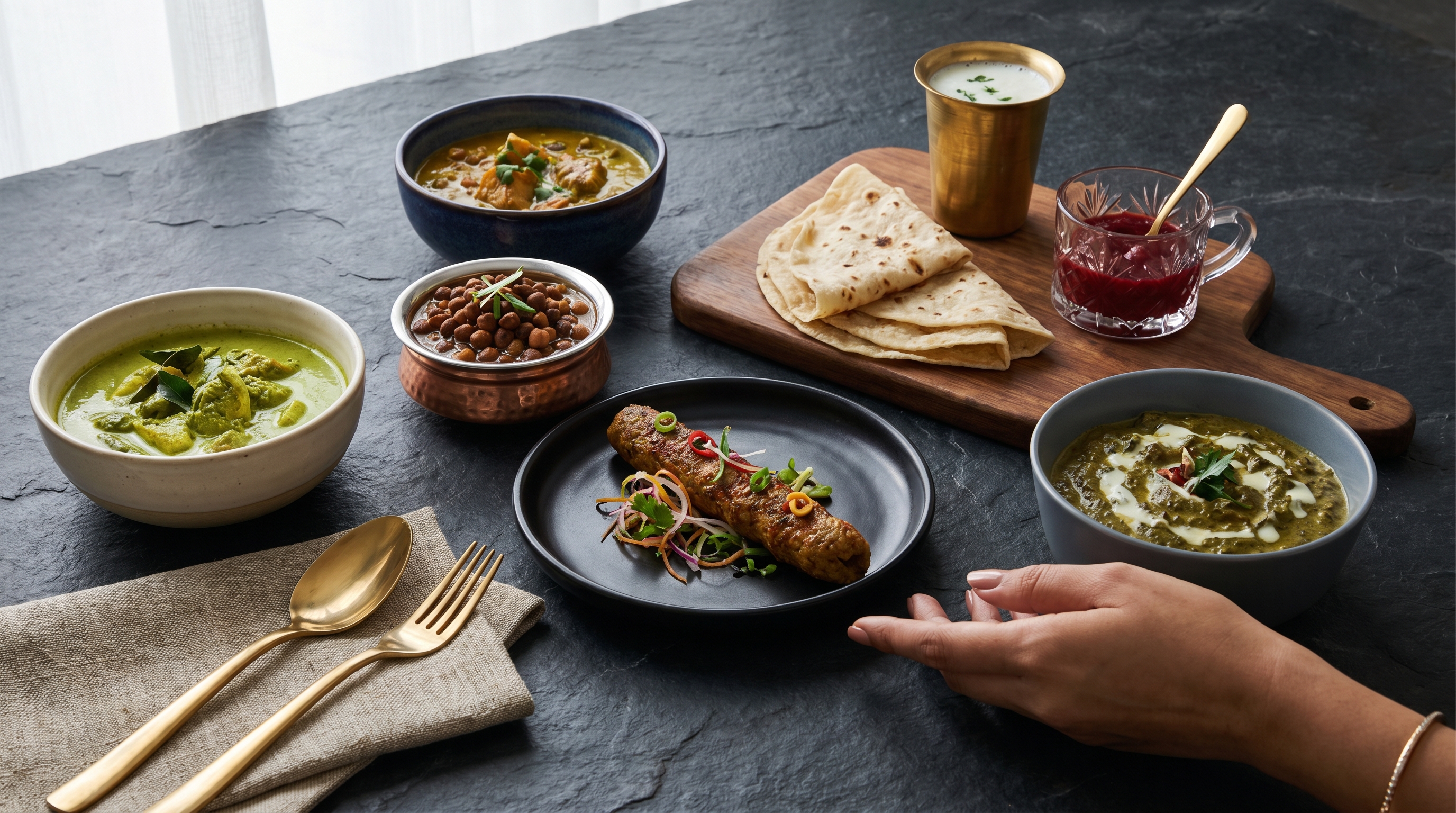
The NRAI's 2024 Food Services Report puts India's restaurant economy at ₹5.69 lakh crore today, growing at 8.1% CAGR to ₹7.76 lakh crore by 2028. The headline number, however, hides where the action actually is. The organised share is moving from 43.8% to 52.9% over the same period — growing at 13.2% versus the unorganised sector's slower drift — which means within four years, more than half of how India eats out will be branded, chain-led, formalised.
That formalisation is happening unevenly across eight categories. Each one tells a different story about what the Indian consumer wants now that didn't exist on the same scale a decade ago.
Regional-Indian premiumisation — the modern Indian wave
Premium-priced regional Indian food is the single biggest editorial story of the last five years. Hunger Inc — the Mumbai group behind Bombay Canteen, O Pedro, Bombay Sweet Shop, Veronica's, Papa's and Enthucutlet — closed FY25 at ₹115 crore in revenue and 9% EBITDA margin, and raised ₹215 crore in 2025 from Lighthouse and DSG Consumer Partners to expand beyond Mumbai. Bombay Sweet Shop alone is more than half of group revenue.
Manish Mehrotra's Indian Accent remains the institutional benchmark for progressive Indian dining in Delhi. Prateek Sadhu's Naar, a sixteen-cover Himalayan tasting destination in Kasauli, was named Discovery Gem at La Liste 2024 and entered Asia's 50 Best radar within twelve months of opening. Avartana at ITC Grand Chola, Chennai, was ranked seventeenth in the world and second in Asia by TripAdvisor Travellers' Choice 2024 — two consecutive years as India's top winner.
Comorin, Mahabelly, Karavalli at Taj West End, Dakshin at ITC, Dum Pukht, Pa Pa Ya, and the late great Bohri Kitchen — chefs and operators are charging fine-dining prices for laal maas, niramish, undhiyu, alleppey curry, kayasth meals, Mappila cuisine. Average ticket: ₹2,000 to ₹6,000 per cover. Five years ago, no Indian diner would have paid this for regional food. Today they are booking two weeks in advance.
Gourmet QSR and the fast-casual upgrade
The Indian QSR market hit USD 27.8 billion in 2025 and is projected to reach USD 47.3 billion by 2031 at 9.3% CAGR. The expansion is franchise-led, tier-2-first, and almost entirely funded by domestic VC.
Wow! Momo crossed 780 outlets in 75+ cities by end-FY26. FY24 revenue was ₹475 crore, up 14% YoY, with FY25 targeting ₹650 crore and an explicit FY27 target of ₹1,000 crore revenue plus 1,000 outlets, en route to an IPO. Wow! Chicken now contributes 55% of group revenue; momo is 35%. Burger Singh closed FY25 at ₹117 crore revenue (50% growth), posted its first positive EBITDA in five years, and raised ₹82 crore Series B at ₹520 crore valuation in March 2026.
The under-reported QSR story of the year is The Belgian Waffle Co. FY25 revenue ₹329 crore, profit ₹35 crore, more than 700 stores across 199 cities. Vixar (Arpwood) bought 45% in December 2025 for roughly ₹770 crore, valuing the chain at ~₹1,700 crore. Boba Bhai went from ₹5 crore to ₹30 crore between FY24 and FY25, raised ₹40 crore in February 2026 at a 5x valuation jump, and is on track for ₹100 crore annualised by mid-2026. The under-25 daypart is now the new battleground.
Speciality coffee and the cafe expansion
Starbucks India's growth has cooled to roughly 5%. The three homegrown speciality chains — Blue Tokai, Third Wave Coffee, and Subko — are collectively crossing ₹600 crore in FY25. This is the defining inversion in Indian F&B this decade.
Third Wave Coffee closed FY24 at ₹241 crore revenue (67% growth), and an unaudited ₹285 crore in FY25. The chain is at 114 cafés as of late 2024, targeting 160 by FY25 close and 80-100 net additions annually from 2026 onwards. Blue Tokai posted ₹216 crore in FY24, with founder Matt Chitharanjan claiming ₹341 crore unaudited in FY25 and 130 outlets today, targeting 350 in three years and ₹1,000 crore by FY27. Subko, the roastery-as-religion play, posted ₹36.1 crore in FY25 and raised a $10M Series B led by Blume Ventures and Nikhil Kamath in January 2024.
Average cafe ticket: ₹350 to ₹500. The cafe ticket is now higher than the QSR food-and-drink ticket. Bengaluru, Pune, Delhi-NCR and Mumbai lead the demand; Indore, Lucknow, Kochi and Chandigarh are the next wave. The expansion thesis is straightforward — every Indian metro can support five to seven anchor speciality chains, and the tier-2 white space is still open.
Cloud-kitchen native brands
The original pure-virtual thesis has dimmed but the operators have not gone away. Rebel Foods (Faasos, Behrouz, Oven Story, Lunchbox, The Good Bowl, Sweet Truth, Mandarin Oak, Slay Coffee) closed FY25 at ₹1,617 crore in revenue, 14% growth — much slower than the chain has historically run — with losses narrowed to ₹336 crore. Food sales remain 97% of operating revenue. Curefoods (EatFit, Sharief Bhai, CakeZone, Olio, Frozen Bottle, Krispy Kreme India) hit ₹746 crore in FY25, 28% growth, filed a DRHP for an ₹800 crore IPO with SEBI, and raised ₹160 crore pre-IPO from Binny Bansal's 3State Ventures. EatClub (formerly Box8) cut its FY24 loss by 77% to ₹15.77 crore — the closest pure-cloud player to profitability. Biryani By Kilo hit ₹268 crore in FY24, with about 70% of revenue from digital orders in 2025 and a clear omnichannel pivot.
The pattern across all four: every serious cloud-kitchen brand is now bolting on physical storefronts. Rebel has opened Sweet Truth physical units. Curefoods is running 40+ physical EatFit outlets. The conclusion the operators have all reached, even if they don't yet say it publicly: pure-virtual is hard to defend without a brand, and brands need a place customers can walk into.
Speciality drinks — craft beer, kombucha, the sober-curious daypart
The Indian craft beer market was USD 4.7 billion in 2024 and is projected to reach USD 33.3 billion by 2033 at 23.4% CAGR. Bengaluru remains the per-capita microbrewery capital of the country. Bira 91 — the brand that defined the first wave — posted ₹638 crore in FY24, down 22% YoY, with ₹748 crore in losses, and is in restructuring after stopping production mid-2024. The slack is being picked up by Simba, White Owl, BeeYoung, Geist, Kati Patang and Arbor.
The kombucha market is now USD 119.9 million in 2025, projected to USD 462 million by 2034 at 16.2% CAGR. Brands worth tracking: Atmosphere, Borecha, Bombucha, Sbooch, Mountain Bee and Toyo. Cold-pressed juice has crossed USD 120 million and is growing at 6.5% CAGR.
The sober-curious wave is structural, not seasonal. Roughly 72% of affluent drinkers across ten Indian cities took a self-imposed alcohol break in 2024. Zero-proof cocktail bars (Lair, Boilermaker, Soka, Sidecar) and specialty kombucha programmes are no longer wellness niche. They are now mainstream daypart strategy at gastropubs that used to derive 60% of revenue from alcohol.
Healthy and diet-conscious — the meal-as-medicine wave
EatFit inside the Curefoods stable hit ₹145 crore in FY25 — the second-biggest brand in the group. Around it sits a cohort of meal-as-medicine plays: Yogi.Fit, Fittr, Bowl Company, HealthifyMe Stores, plus hyperlocal protein-bowl and salad-bar formats now scaling inside Bengaluru, Hyderabad and Pune office clusters.
The category's economics work differently from regular delivery food. Order frequency is higher (often subscription-based), customer LTV is longer (12-18 months versus 3-6 for general delivery), but AOV is lower (₹250-350) and gross margins are tighter. The brands that crack it have built a recurring-revenue mental model on top of restaurant operations. The brands that haven't are stuck in low-margin delivery hell with health positioning that the customer doesn't pay extra for.
Dessert and the sweet shop reinvention
Bombay Sweet Shop — Hunger Inc's modern mithai brand — is now more than 50% of group revenue. The packaging discipline borrowed from luxury chocolatiers, paired with Indian halwai craft, has produced a SKU library that travels (gift, wedding, festival) and a unit economic profile dine-in restaurants envy.
Khoya Mithai posted ₹7.3 crore in FY24, runs pan-India 48-72-hour delivery, and collaborates with Le Cordon Bleu chefs and food historians on small-batch heritage launches. Deliciae, Bunty Mahajan's twenty-year-old patisserie, did 3.8 lakh orders in 2024 with 67% YoY growth and caters the Ambanis, Godrejs and Bachchans. Concu in Hyderabad, Theos in Delhi-NCR, Magnolia Bakery India, Brik Oven and Le 15 are pushing modern patisserie into tier-2.
The Indian dessert market is projected to hit ₹587.9 billion by 2032 at 8.1% CAGR, and the bakery industry will cross USD 17.4 billion by 2028. The single hottest sub-trend, watch closely: traditional mithai re-engineered for gifting, with packaging design and SKU discipline borrowed from luxury cosmetics. The unit economics are kinder than any restaurant on the planet.
Pop-ups, festival dining and the chef's-table economy
Ramadan iftar pop-ups on Mohammed Ali Road in Mumbai, Charminar in Hyderabad and Frazer Town in Bengaluru now have aggregator listings and ticketed food walks. Chef's-table formats (Masque in Mumbai, Avartana in Chennai, ZLB23 in Bengaluru, the chef's table at Comorin in Delhi) routinely sell out two weeks ahead at ₹4,500 to ₹9,500 per cover. Heritage pop-ups — Bohri, Sindhi, Kayasth, Pathare Prabhu, Tamilian temple cuisine, Mappila — have become this generation's equivalent of Mumbai's khau gallis, except ticketed and Instagram-led.
The dark-matter underneath all of this is the Indian wedding economy. The Confederation of All India Traders puts the October-December 2024 wedding season at ₹6 trillion of business across 4.8 million weddings, with an average spend of ₹36.5 lakh and destination-wedding average at ₹51.1 lakh. The wedding-driven F&B catering market alone is the silent engine under most of the hospitality talent shortage every operator complains about.
Eight more concepts that aren't yet big but are getting press and capital
For watchers, not investors yet:
- Mexican and Latin — Sanchez in Mumbai, Maya, Pa Pa Ya's Latin spin-offs
- Vietnamese and South-East Asian — Foo in Mumbai, Misu, Ban Ganapati
- Mediterranean and Levantine — Olive's reinventions, Komorebi, Bayroute
- Plant-forward, not vegan-marketing-led — Greenr, ARQ, Veganarke
- Pickle and fermentation brands — Pahadi Pickles, The Sirona Co
- Single-origin Indian chocolate — Mason & Co, Subko Chocolate, Soklet
- High-end thali experiences — 1Q1 by Chef Vikas Khanna (NYC and Mumbai roadmap)
- Sushi, omakase, hand-pulled noodles, done locally — Wakai, KOKO, Otoyaa in Bengaluru, Hakkasan's renewed India push
This blog is a free editorial project. Kaam Hire — the hospitality-only hiring platform behind it — is a paid product for restaurant operators. More about Kaam Hire.
Sources & references 8
- NRAI India Food Services Report 2024
- Restaurant India — Hunger Inc raises ₹215 crore
- Startuppedia — Belgian Waffle Co FY25 numbers
- Outlook Business — Boba Bhai ₹40cr at 5x valuation
- Entrackr — Rebel Foods FY25 ₹336 cr loss
- Entrackr — Blue Tokai FY24 revenue
- IMARC — India craft beer market 2024-33
- The Arc — Starbucks India vs Blue Tokai / Third Wave
Kaam Hire is the hospitality-only hiring platform that powers this blog. If hiring is on your mind — try it.