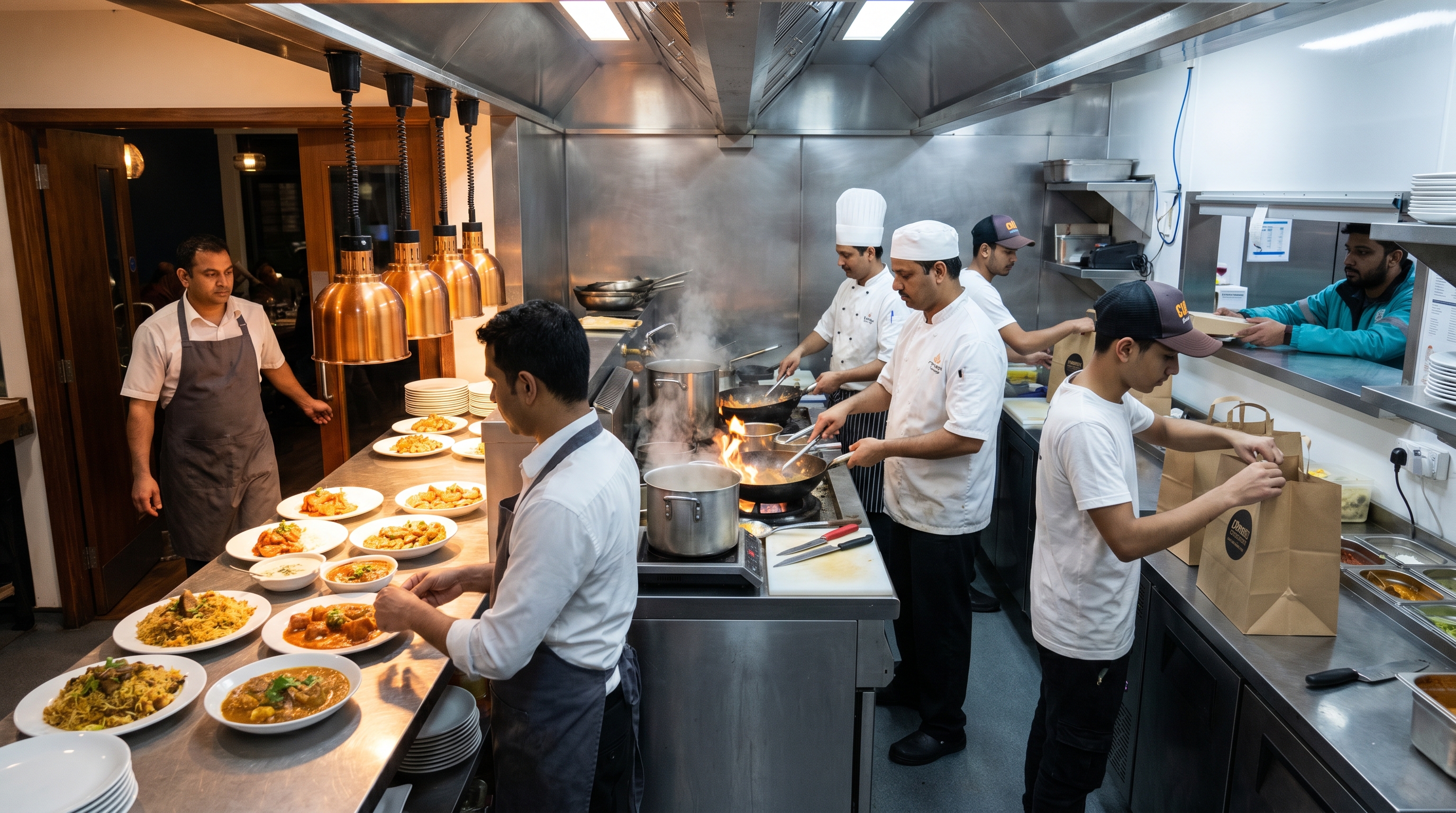
In 2021, the case for cloud kitchens looked unanswerable. Lower capex, lower rent, no front-of-house overhead, faster breakeven, scalable. The funding flowed accordingly — Rebel Foods at a $1.4 billion valuation on a Qatar Investment Authority-led round, Curefoods raising at unicorn-adjacent prices, Box8 at $40 million, an entire generation of operators told that physical restaurants were a legacy format.
Five years later, the picture has rearranged. Rebel Foods posted a ₹336 crore net loss on ₹1,617 crore revenue in FY25. Curefoods posted a ₹170 crore net loss on ₹746 crore revenue in the same year. Meanwhile, the listed physical-restaurant operators — Devyani International (KFC, Pizza Hut, Costa), Sapphire Foods (KFC, Pizza Hut), Westlife Foodworld (McDonald's West & South), Restaurant Brands Asia (Burger King India) — were broadly profitable or close to it, with lower headline IRRs but real cash generation.
The lesson buried in those numbers is more interesting than either side's marketing department wants to admit.
The head-to-head, 2026 numbers
| Metric | Cloud kitchen (600-1000 sqft, single brand) | Cloud kitchen (1500 sqft, multi-brand) | Physical dine-in (30 seater) | Physical dine-in (50-80 seater) |
|---|---|---|---|---|
| Total capex | ₹8-20 lakh | ₹25-45 lakh | ₹35-75 lakh | ₹75 lakh - ₹1.5 Cr |
| Interiors / fit-out | ₹2-4 lakh | ₹5-8 lakh | ₹15-30 lakh | ₹30-70 lakh |
| Kitchen equipment | ₹2-6 lakh | ₹6-12 lakh | ₹4-10 lakh | ₹8-15 lakh |
| Security deposit | ₹1.5-4 lakh | ₹4-9 lakh | ₹6-15 lakh | ₹15-40 lakh |
| Licences + NOCs | ₹30-50 K | ₹50K-1L | ₹1-2.5 lakh (incl. liquor) | ₹2-10 lakh (liquor ₹5-15L alone) |
| Working capital (3 mo) | ₹3-5 lakh | ₹6-10 lakh | ₹8-15 lakh | ₹15-30 lakh |
| Rent as % of revenue | 3-6% | 4-7% | 8-15% | 10-18% |
| Labour as % of revenue | 12-18% | 15-20% | 18-25% | 20-28% |
| COGS | 28-32% | 28-32% | 28-32% | 28-34% |
| Aggregator commission | 25-35% of delivery (which is 85-90% of revenue) | 25-35% | 25-35% on the 30-50% that's delivery | Similar, capped by dine-in mix |
| Marketing | 8-15% (platform ads) | 10-15% | 4-8% (location-led) | 5-10% |
| Breakeven | 6-12 months | 9-15 months | 18-30 months | 24-36 months |
| Target EBITDA | 8-15% | 10-18% | 12-18% | 15-22% (mature) |
| Payback period | 12-24 months | 18-30 months | 30-48 months | 36-60 months |
| IRR (well-run) | 30-50% | 25-45% | 18-28% | 18-25% |
| Closure rate, Year 1 | 25-30% | 30-40% | 20-25% | 15-20% |
Sources: NRAI 2024; Restroworks; Inc42; BBFT; Skope Kitchens; operator interviews. Numbers are credible operating ranges, not point estimates.
The table tells most of the story. Cloud has lower capex, faster breakeven, higher headline IRR. Physical has higher capex, slower breakeven, lower IRR, but a real asset and a defensible brand. That much was true in 2018, in 2021, and is still true in 2026.
The interesting part of the comparison is everything the table can't capture.
The dine-in AOV is 2-3x delivery AOV — and that's before alcohol
A Social or Smoke House Deli ticket runs ₹800 to ₹1,200 per cover with beverages. The same brand on Zomato struggles to break ₹450. The 2-3x gap holds across most premium-casual formats.
Beverage attach rate is the second driver. Dine-in beverage attach runs 35-45% of bill value. Delivery beverage attach is 8-12%. The customer who walks in orders a starter, a main, a drink, often a dessert. The customer who orders on Swiggy orders the main, maybe a side, almost never a drink.
The third — and this one is structural — is alcohol. Alcohol is 25-40% of revenue at gastropubs, with gross margins of 60-70%. It is the single highest-margin revenue line in the Indian restaurant business. And it is legally physical-only. No cloud kitchen can replicate this revenue line. This is the reason Impresario's Riyaaz Amlani is building Social into fifteen stores by end-2025, not a delivery brand.
The aggregator commission is the new rent
The old restaurant economic frame: rent is the largest fixed cost, 10-15% of revenue. The new cloud-kitchen economic frame: aggregator commission is the largest variable cost, 25-35% of revenue, and it's a duopoly.
Swiggy and Zomato together hold 90%+ of the platform-to-consumer market. The platforms hiked their platform fee to ₹17.58 per order in March 2026. Zomato added long-distance delivery fees in July 2025. Both adjustments were made unilaterally.
A cloud kitchen has lower rent than a comparable physical restaurant, but it is paying a far higher "platform rent" — and the platform can change the deal at any time. The platforms also run their own kitchens (Swiggy's Bowl Company, Zomato's Hyperpure-backed brands) which are direct competitors to their restaurant partners. Curefoods explicitly flagged this as a key risk in its DRHP. Pure-play cloud kitchens are tenants on a platform whose landlord is also their competitor.
Rapido's 2025 entry into food delivery at an 8-15% commission is the only structural relief on the horizon. Whether it scales to genuine duopoly-breaking volume is the open question of 2026-27.
The biggest cloud kitchens are still losing money
The four largest pure-play cloud kitchen operators in India, FY25 numbers:
- Rebel Foods: Revenue ₹1,617 crore (14% YoY growth, slowing), net loss ₹336 crore. The chain spent ₹1.23 to earn ₹1 of revenue.
- Curefoods: Revenue ₹745.8 crore (27.5% growth), net loss ₹170 crore, EBITDA loss narrowed from ₹276 crore to ₹58 crore. SEBI approval received for an ₹800 crore IPO.
- EatClub (formerly Box8): Revenue ₹515.5 crore in FY24, loss cut 77% to ₹15.77 crore. Closest to profitability among pure-play cloud kitchens.
- Biryani By Kilo: Revenue ₹268 crore in FY24, losses down 30%. The structural pivot to omnichannel (now 30% non-delivery revenue from physical takeaway and dine-in) was the operational reset.
The listed physical-restaurant operators, by contrast, are profitable or close to it. They have lower IRRs on paper, but they generate cash. Devyani International had EBITDA margin of 16-18%, Sapphire Foods at 15-17%, Westlife at 13-15%. Restaurant Brands Asia (Burger King India) is the only loss-making name in the listed dine-in cohort, partly because the BK Cafe expansion is still in investment mode.
The pattern across the segment, in plain terms: the cloud kitchen model produces high marginal returns at unit level but fails to compound at company level, because aggregator commissions cap the EBITDA ceiling.
The funding correction is structural, not cyclical
The 2021-22 cloud kitchen FOMO money — Rebel's $175M round from QIA at a $1.4 billion valuation, Curefoods at near-unicorn prices, Box8 raising $40M — has been replaced by 2024-25 down-rounds and flat-rounds. EatClub raised at $540 million post-money on a 2025 Tiger Global round, flat to its prior round. The market has priced in: cloud-only doesn't get to profitable without scale most operators can't reach.
The other side of the same year tells the opposite story:
- The Belgian Waffle Co sold 45% to Vixar/Arpwood in December 2025 at ~₹1,700 crore valuation, on ₹329 crore revenue and ₹35 crore profit.
- Hunger Inc closed ₹215 crore in 2025 on ₹115 crore revenue at 9% EBITDA margin.
- Burger Singh raised ₹82 crore Series B at ₹520 crore valuation on ₹117 crore revenue.
- Theobroma sold 90% to ChrysCapital at ₹2,410 crore in July 2025.
The capital has moved from pure-virtual to brand-led, hybrid, and physical-first plays with a profitable unit economic story.
The hybrid model is winning the argument
The brands that are scaling profitably in 2025-26 are running hybrid:
- Biryani By Kilo runs 100+ kitchens with roughly 30% revenue from dine-in and takeaway, 70% from delivery.
- Wow! Momo runs 850+ outlets with both QSR storefronts and aggregator delivery. EBITDA-positive at 6-7% at the corporate level, with founder Sagar Daryani targeting ₹1,000 crore revenue and an IPO by 2027.
- Rebel Foods has begun opening Sweet Truth physical stores. The thesis: physical for brand reinforcement, cloud for unit economics.
- Curefoods has more than 40 EatFit physical outlets alongside its cloud kitchen network.
- Theobroma, Belgian Waffle Co, Burger Singh have always been physical-first with delivery as a layer.
The pattern across all of them: physical for brand reinforcement and dine-in AOV (which is structurally 2-3x delivery AOV), cloud for unit economic flexibility and city expansion velocity.
The reverse model — pure cloud, then bolt physical on top — has worked operationally in a couple of cases but has not produced a profitable company at the corporate level yet. The conclusion most operators have quietly reached: build the brand in physical first, extend to cloud second.
Where direct channels are starting to matter
For most cloud kitchens, direct-channel revenue is 5 to 15% of total. For a few brands that have built it intentionally, the share is 12 to 20%. That difference, on a 20-25% gross-to-net spread between direct and aggregator economics, is worth 3 to 5 percentage points of EBITDA.
The direct-channel options worth tracking:
- Petpooja, with 50,000+ outlets and a native online-ordering layer that bypasses aggregator commissions.
- DotPe / Rista, with closer WhatsApp and direct-payment integration.
- uEngage, focused on restaurant-owned ordering infrastructure.
- ONDC, live across major cities in mid-2025 with 2-7% commission caps, and the government earmarking ₹100-150 crore in subsidies for buyer apps (Magicpin, Paytm, Ola Consumer, Waayu).
- WhatsApp catalogue ordering for small operators not yet at the scale that justifies a dedicated direct-order platform.
The strategic target most serious operators in India set in 2026: 20-30% of delivery revenue through direct channels within 12-18 months. The brands that hit that ratio have a defensible margin profile. The brands that don't are running on aggregator economics, full stop.
Physical wins on labour productivity per crore at scale
This is the less-discussed flip. A 50-seater Social does ₹1.5 to ₹2.5 crore a year with 30-40 staff. A multi-brand cloud kitchen does ₹1.5 to ₹2 crore a year with 12-18 staff. By the headline number, the cloud kitchen wins on labour-per-revenue.
But the labour at the cloud kitchen is interchangeable, low-skill, and the brand has no defensible customer loyalty. The 30-40 staff at the Social are the brand. They are the captains the regulars know by name, the bartenders who recognise the drink order, the chef whose social-media following brings ten covers a night. Physical takes longer to break even, but it builds an asset — a brand that customers walk into.
Cloud kitchens build a P&L. Physical restaurants build a brand. The hybrid model, as it has emerged in 2024-26, is the only one that builds both at scale.
What the next 24 months will tell us
Three things to watch:
- The Curefoods IPO. If it lists and trades above issue for six months, it validates the pure-cloud-kitchen public-market thesis for the first time. If it doesn't, the next operator with a similar profile will find it hard to raise growth capital in private markets.
- The Sapphire-Devyani merger talks. A consolidated Yum! India franchise will reshape QSR labour markets, supplier negotiations, and aggregator commission economics simultaneously.
- Rapido's food delivery scale-up. If Rapido reaches 10-15% market share at 8-15% commission, the entire economic frame of Indian delivery shifts. If it stalls below 5%, the Swiggy-Zomato duopoly hardens for another five years.
The cloud kitchen model isn't dead — that headline has been wrong every time it has been written. But the version of cloud kitchens that worked in pitch decks five years ago, the pure-virtual, multi-brand, aggregator-dependent thesis, is no longer the live one. The version that works in 2026 is hybrid, brand-first, with direct-channel discipline and a defensible reason for the customer to want what you make, regardless of whether they walk in or order in.
The economics will always favour whichever model gets that part right.
Sources & references 7
- Entrackr — Rebel Foods FY25 ₹336 cr loss
- Inc42 — Curefoods IPO recipe
- Restroworks — Cost of opening a restaurant in India
- Datum Intelligence — Zomato 57% vs Swiggy 43%
- Inc42 — Cloud kitchen opportunity & market challenges
- Business Standard — Rapido low restaurant commission
- BBFT — Economics behind the rise of Faasos cloud kitchens
Kaam Hire is the hospitality-only hiring platform that powers this blog. If hiring is on your mind — try it.